

A long period of dry weather recently gave my son and me a chance to go climbing at High Crag, on the moors not that far from Stump Cross Caverns. We did some fun climbing, on a glorious day, and on a great crag that we had to ourselves.
There is more than one place called High Crag in the UK. The High Crag that I recently visited with my son sits on the top of Craven Moor on the border between Nidderdale and Wharfedale in the Yorkshire Dales. It’s about three-quarters of a kilometre south of Stump Cross Caverns and it’s clearly visible from the road that runs past this show cave. The Ordnance Survey map for Nidderdale refers to it as “High Crag or Rear Clouts,” which is an interesting alternative name that I would be intrigued to know the origins of.
I’ve often looked at High Crag from a distance when I’ve been walking in the area and wondered what the climbing is like up there. The available information made bouldering at High Crag sound very appealing, with the guide by Unknown Stones describing High Crag as a:
“Smart little edge and boulders with a useful collection of routes and problems in a convenient and fine location. Worth a visit.”
It also noted a good collection of easier problems. This meant that it might be a suitable venue for a family climbing trip.

Unfortunately, from the information I found on High Crag it was clear that you needed to time your visit carefully. High Crag’s exposed position on moorland means that it is unlikely to be a welcoming and relaxed place to climb in windy weather. In addition, the Yorkshire Gritstone guidebook entry for the crag states that it is “a bit damp and green in a normal winter” (p.368). The Unknown Stones guide simply states: “Worth avoiding in winter” and goes on to say that the approach can be boggy. This has meant that for the last few years I’ve been waiting for a time when my diary and a long period of dry weather coincide so that I can head up onto Craven Moor to try out High Crag’s bouldering opportunities. That time came a few weeks ago. A bonus was that my son was interested in coming to climb with me, and so on a sunny Sunday morning we packed up the car and headed into the Dales.
I was a bit puzzled as I approached Stump Cross Caverns to see cars and white trailers parked on the moor on the opposite side of the road from the cave entrance. It was only after I’d parked in a grassy layby a little further down the road that I could see what was going on. Motorbikes were bumping and curving their way across the rugged moorland, doing laps around a cluster of spectators. I was surprised as this was the first time I’d seen this in the Dales, but I imagined that for the local farmer renting this piece of land for motocross meets was probably a useful source of extra income.
My son and I left the motorbikes behind to go through a gate on the other side of the road and down to the bed of a dry valley. We followed this uphill to cross a stile in a drystone wall, on top of which someone had place a sheep’s skull (which my son thought was very cool). It was then just a matter of following that wall up the steep side of the valley and then over the moor to High Crag.

A sign on the stile had warned of mine workings in the area, and there were a lot of them to watch out for. There were eroded spoil heaps off to our left, while the intermittent, faint path that we followed regularly passed overgrown mine shafts. Although quite a few of the holes looked more like shake holes than mine shafts to me. One relatively gigantic hole seemed to be the nesting site of a flock of partridges, which ran around and flew up as we walked between the hole and the drystone wall.
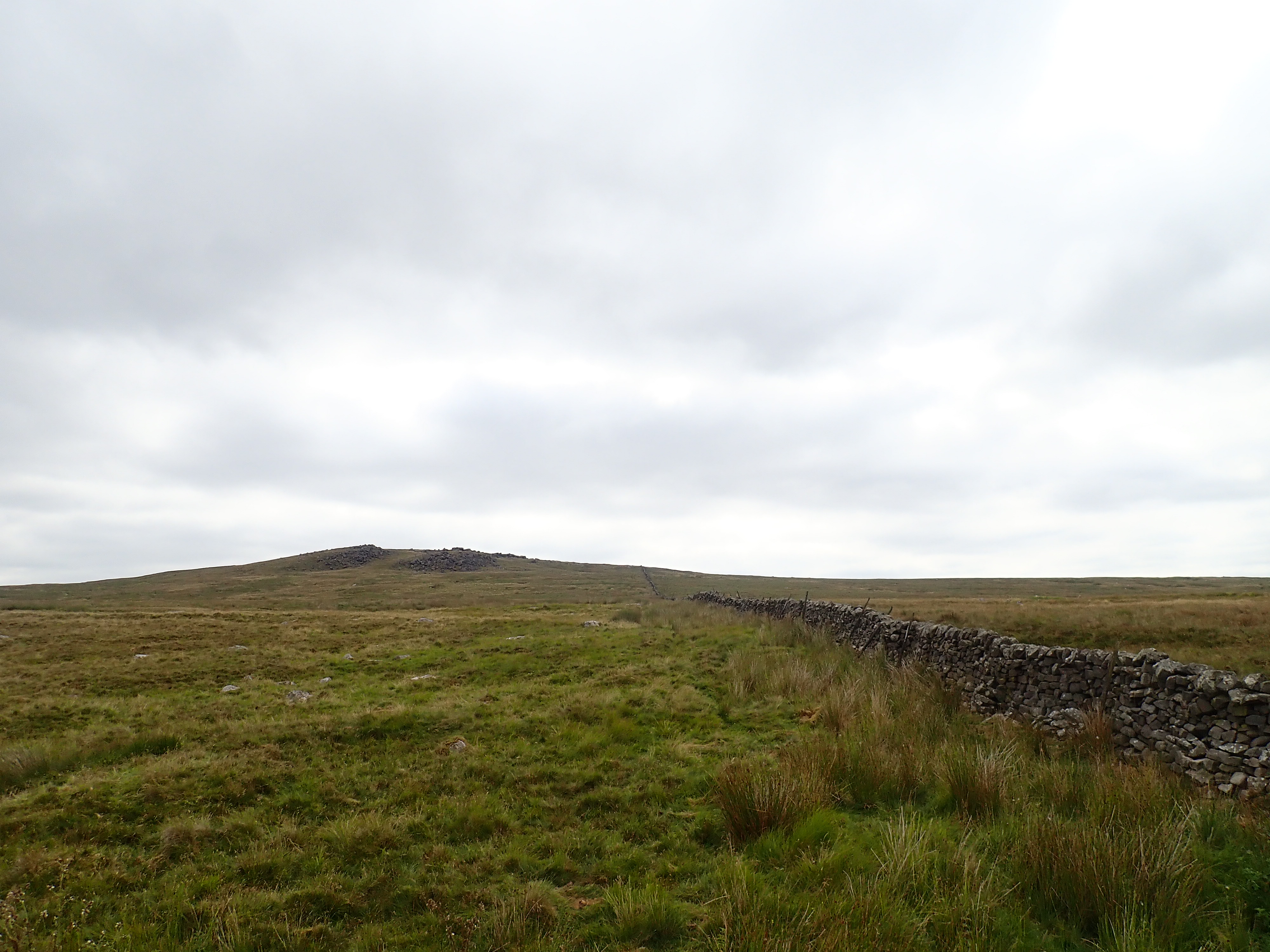
A couple of boulder fields on the horizon were the first part of High Crag that we saw. However, these apparently don’t have any climbing on them, and it was an edge of gritstone that we were aiming for. It was only as we got higher that a jagged line of rock gradually appeared in the distance, rising from the moorland. Our route had been grassy with patches of reeds, but as we got closer to the boulder fields we had to step around large tussocks and more extensive reed beds. The final stretch to the edge of High Crag was over soft and springy moss, with more patches of reeds. It was clear that our approach to High Crag would have been much harder going if there hadn’t been a long period of dry weather.

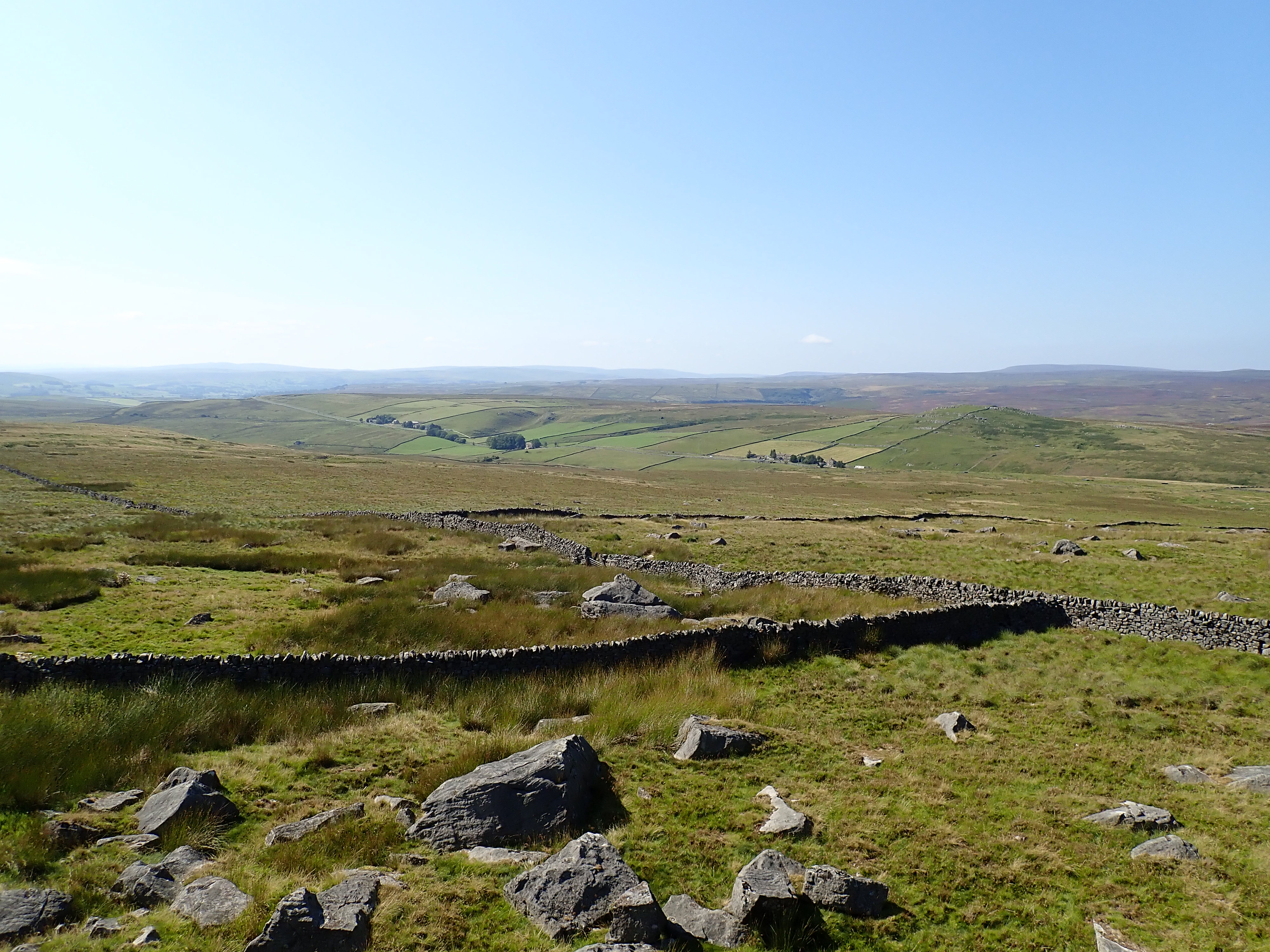
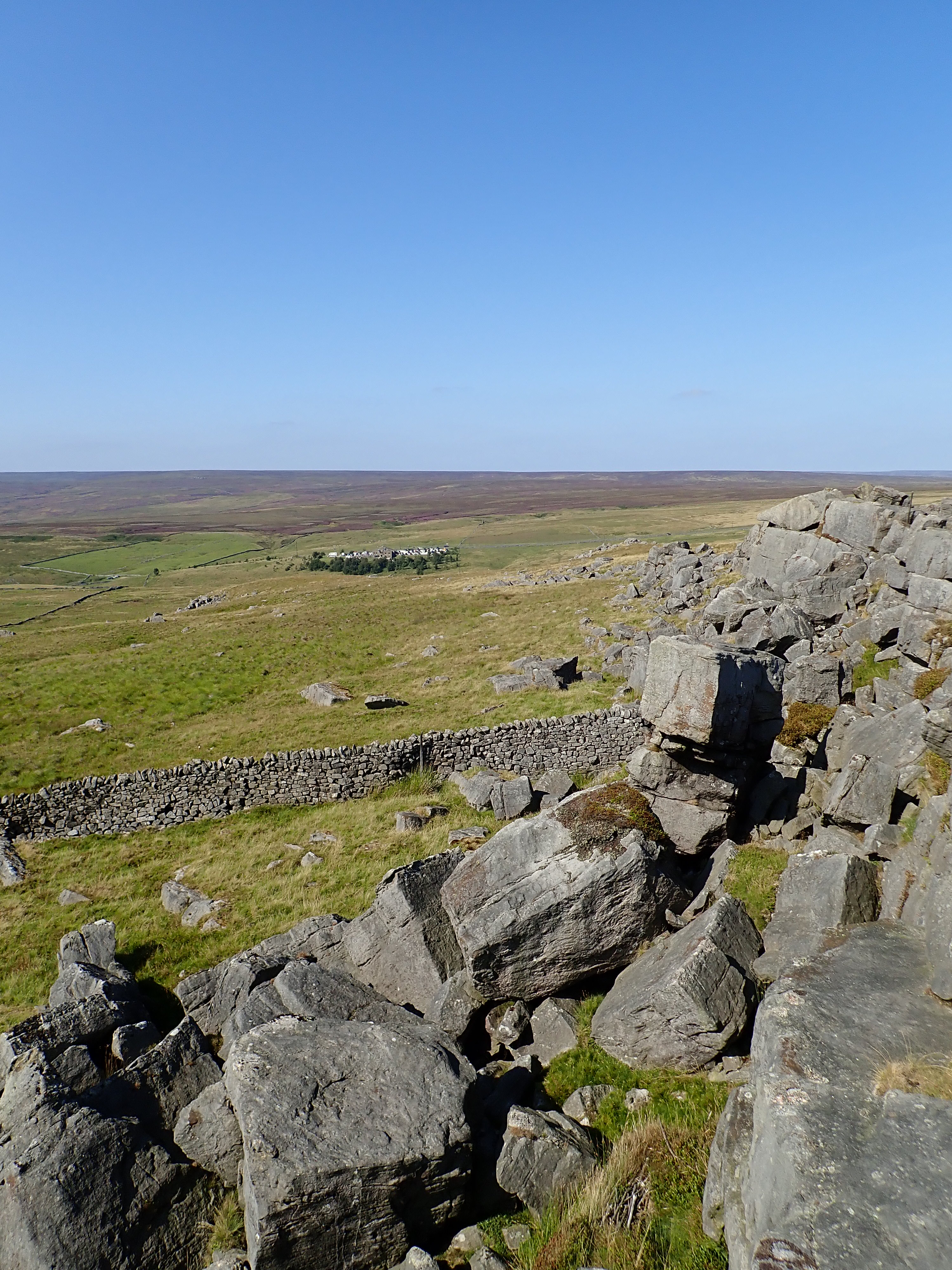
The sweeping views from High Crag of Stump Cross, across to Appletreewick Moor, into Wharfedale, and even to Simon’s Seat on Barden Fell, were amazing. I’m also fairly sure that the peak I could see in the far distance was Great Whernside. Together with warm sunshine and a cooling breeze, the conditions and location were fantastic.
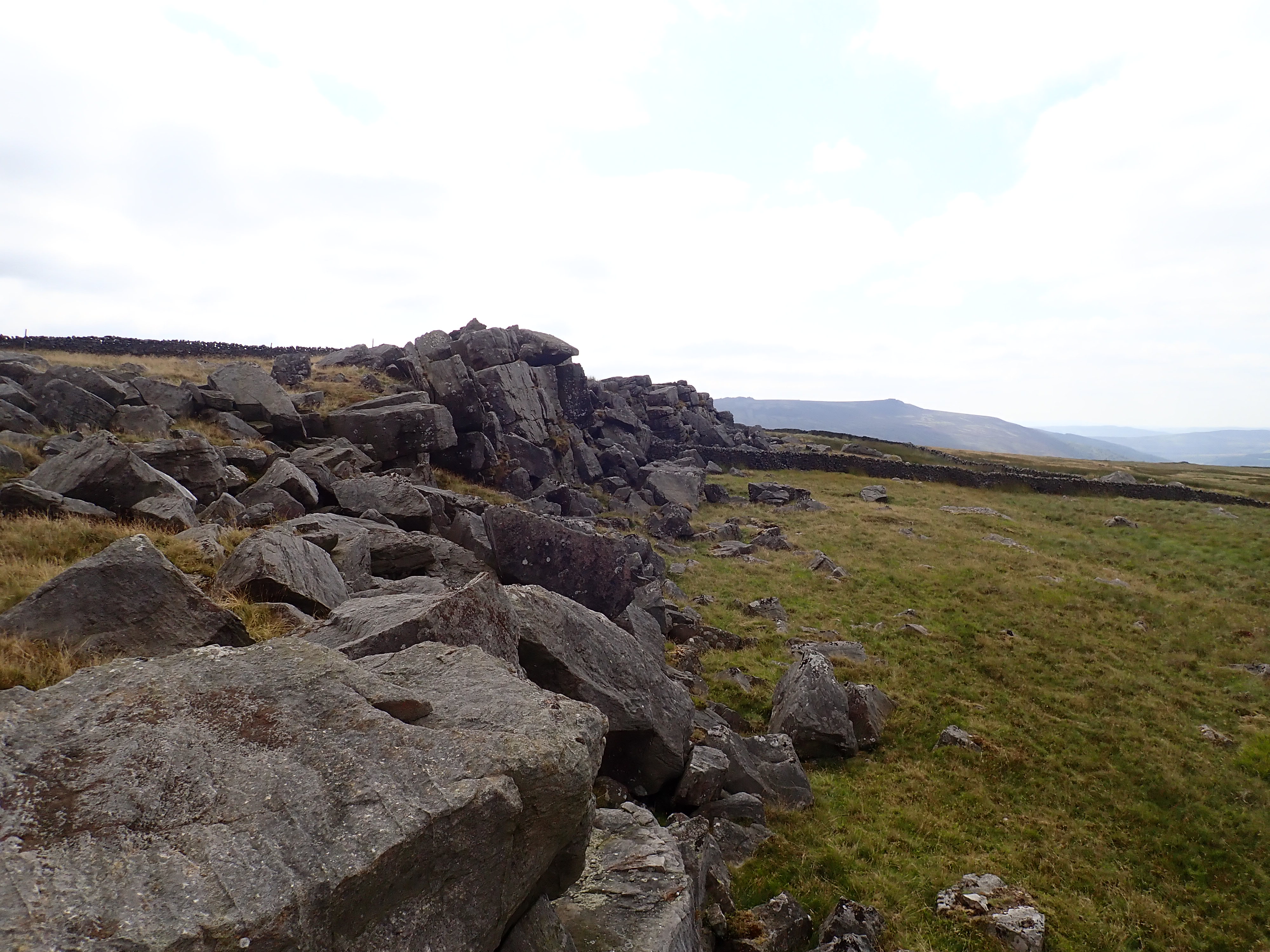
We started our bouldering on the Rough Boulder at the left end of the edge. In Fe (f3), Fi (f2), and Fo (f2), this area has a nice cluster of easier problems good for warming up and for my son to try. He legitimately asked where the problem Fum was, and I replied that it wasn’t in the guide.
My son was hesitant about climbing up the rippled holds of Fo. In particular, he was unconvinced that pinching one of the waves of rock was really a way of holding on. However, he was good at identifying possible holds and planning his moves and was quickly at the top. He was elated that he had completed the problem, and his hesitancy was gone when he climbed other problems that day.
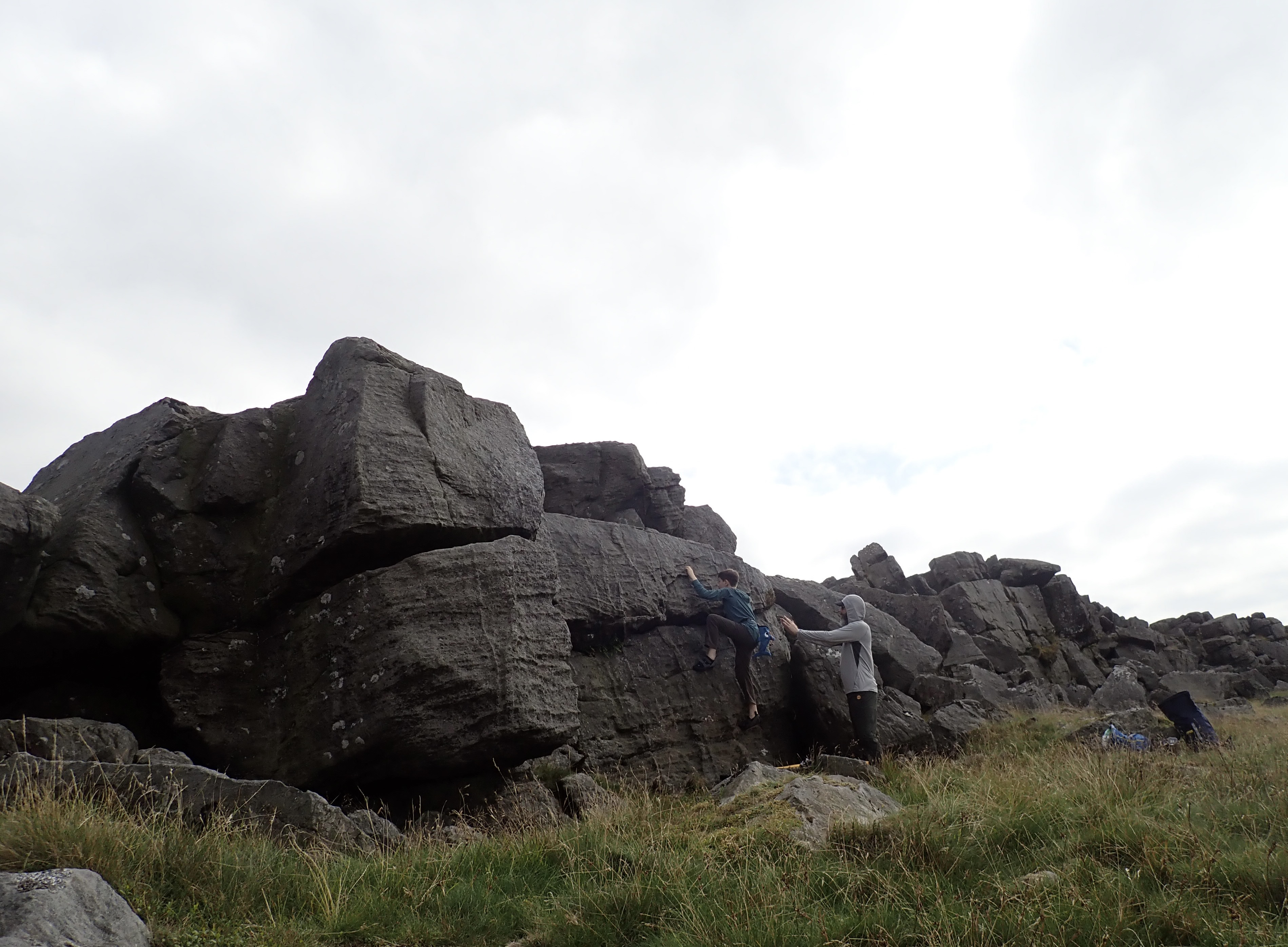

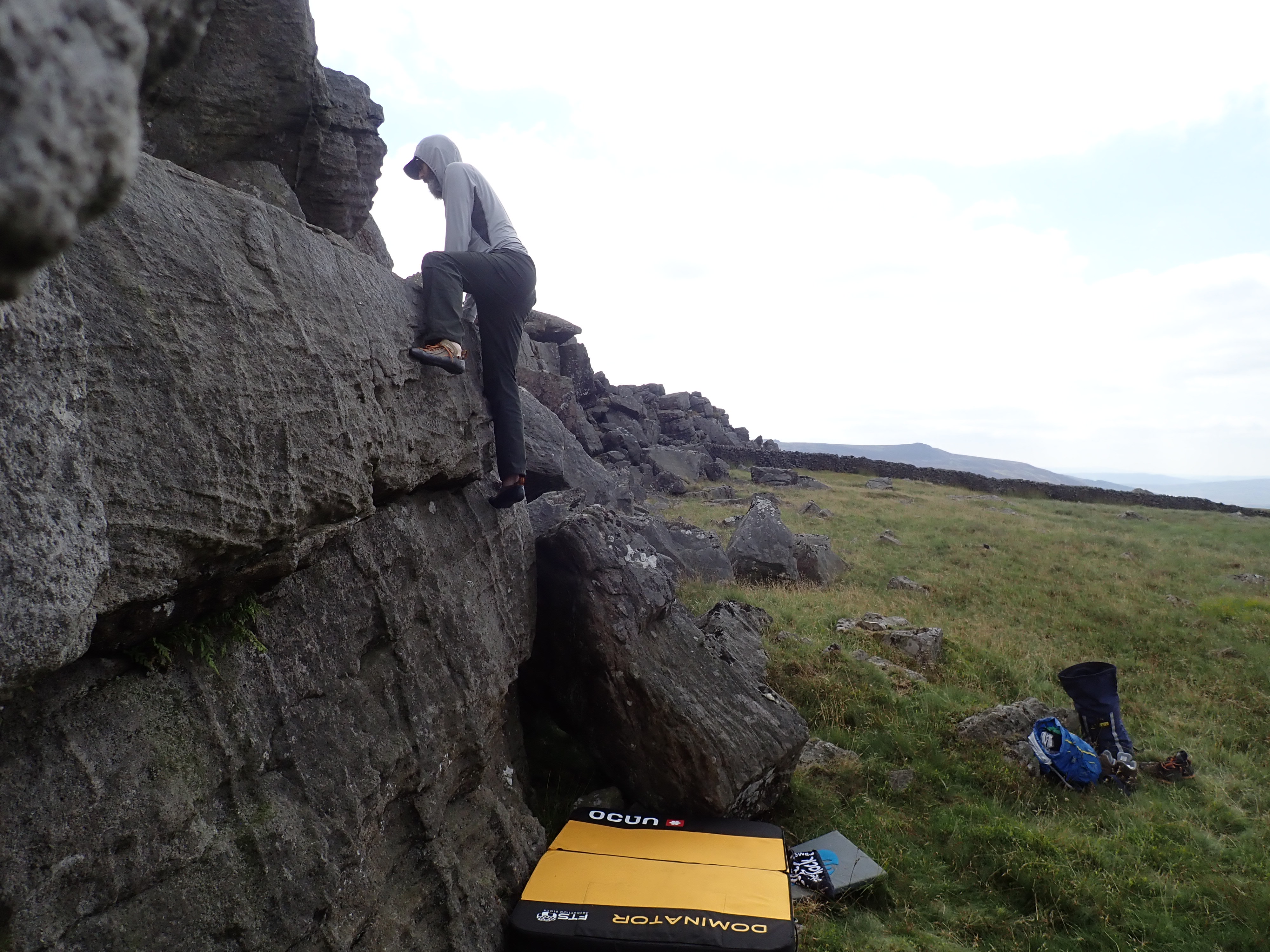
I enjoyed the problems on the Rough Boulder. The gritstone was nicely rough, the holds were interesting, and the climbing felt more like play than a struggle. Unfortunately, the same was not true of the problem Corner Climb (f2) on the Three Aretes Boulder a little further along the edge. My son made a valiant effort to climb this crack and corner, but after several tries he stepped back onto the mat and admitted that he didn’t know how to do it. I topped out on Corner Climb but found the climbing to be unpleasant and harder than its given grade. We decided to move on to the climbing at the other end of the edge.
Getting to the Right Edge of High Crag involves scrambling around the end of the drystone wall that we had followed on our way up the moor. This wall finishes against the crag, and so, after throwing the bouldering mats over the wall (which my son enjoyed doing), we clambered on the wall and the rock to get past it.
The photo of Right Edge in Unknown Stones’ guide didn’t give me a sense of the scale of this part of the crag. I was surprised to find that it was much taller than I had imagined, and that most of the problems were high balls. I felt it was unsafe for my son to try a high ball, and I didn’t want to put him into the situation of having to call mountain rescue if I took a bad fall from one. Thankfully, a couple of the problems at the far end of the crag looked manageable, with one ending at a large ledge and the other easy to finish early stepping off onto this ledge.
My son put in a good effort on both the problems but decided that they were too hard for him after a few moves and climbed down. I had fun going up them.
It was beginning to get a little late, so we packed up our things and retraced our steps down the moor. We then took a side trip to the café and giftshop at Stump Cross Caverns, before heading for home. My son later said that he’d enjoyed the trip, and I’d enjoyed going climbing with him, particularly in such a fantastic location.

Further information
There is a downloadable guide to the climbing at High Crag on the website Unknown Stones.
There is also a short section on the climbing at High Crag in the guidebook Yorkshire Gritstone, Volume 1: Almscliff to Slipstones.
 the Severe climber
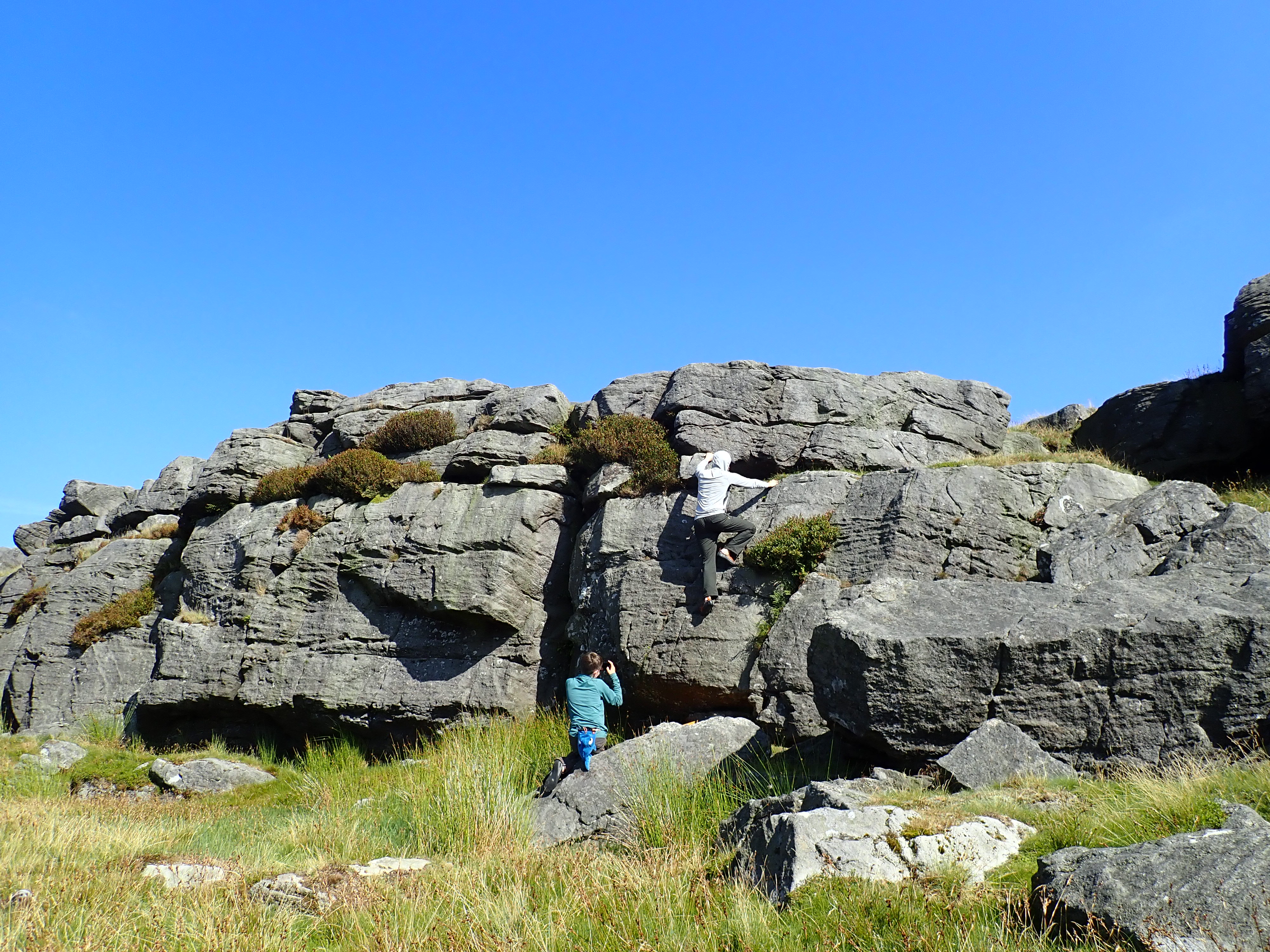
Didn’t know anything about that location – nor have I ever noticed it in the distance when on that road so that was interesting. Who took the photo with you both in it?
Hi.
I put my camera up on a mini tripod and set it on timer. It’s a little bit of effort, but it does mean that I can get photos of us together.
Best wishes,
Robin