
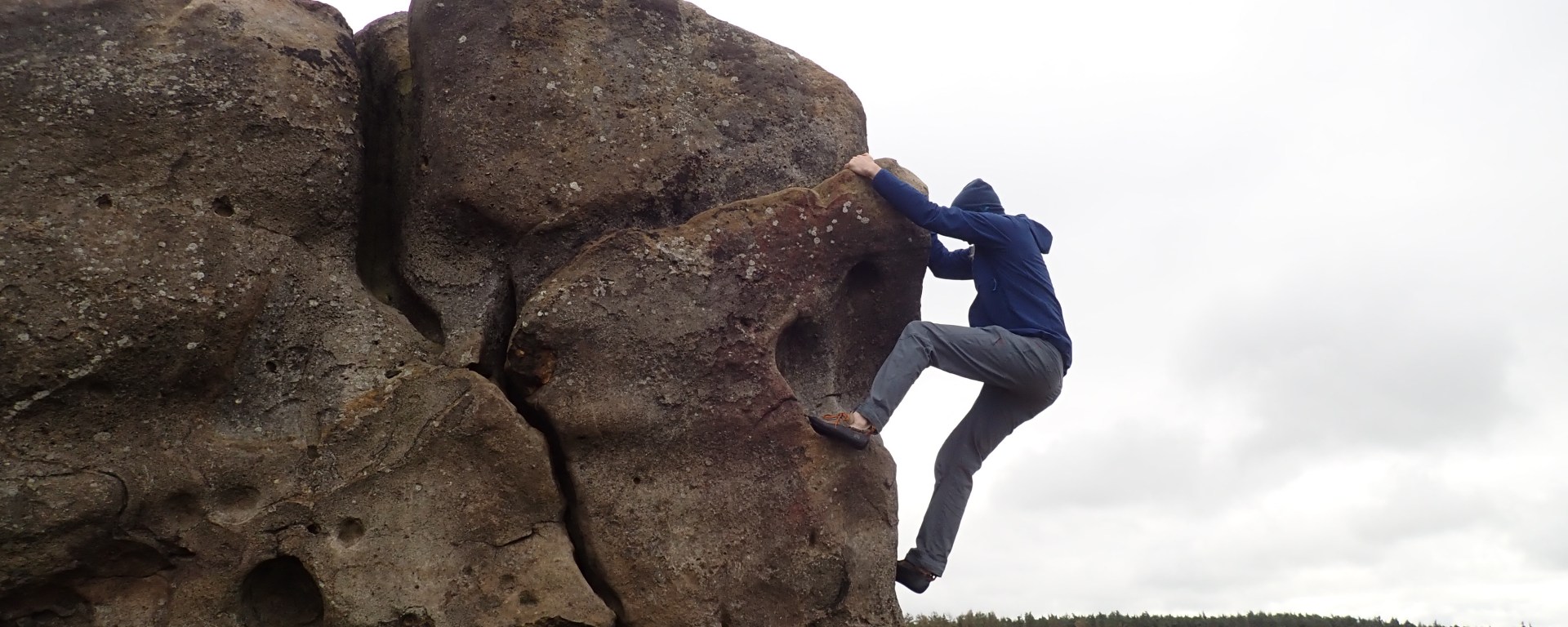
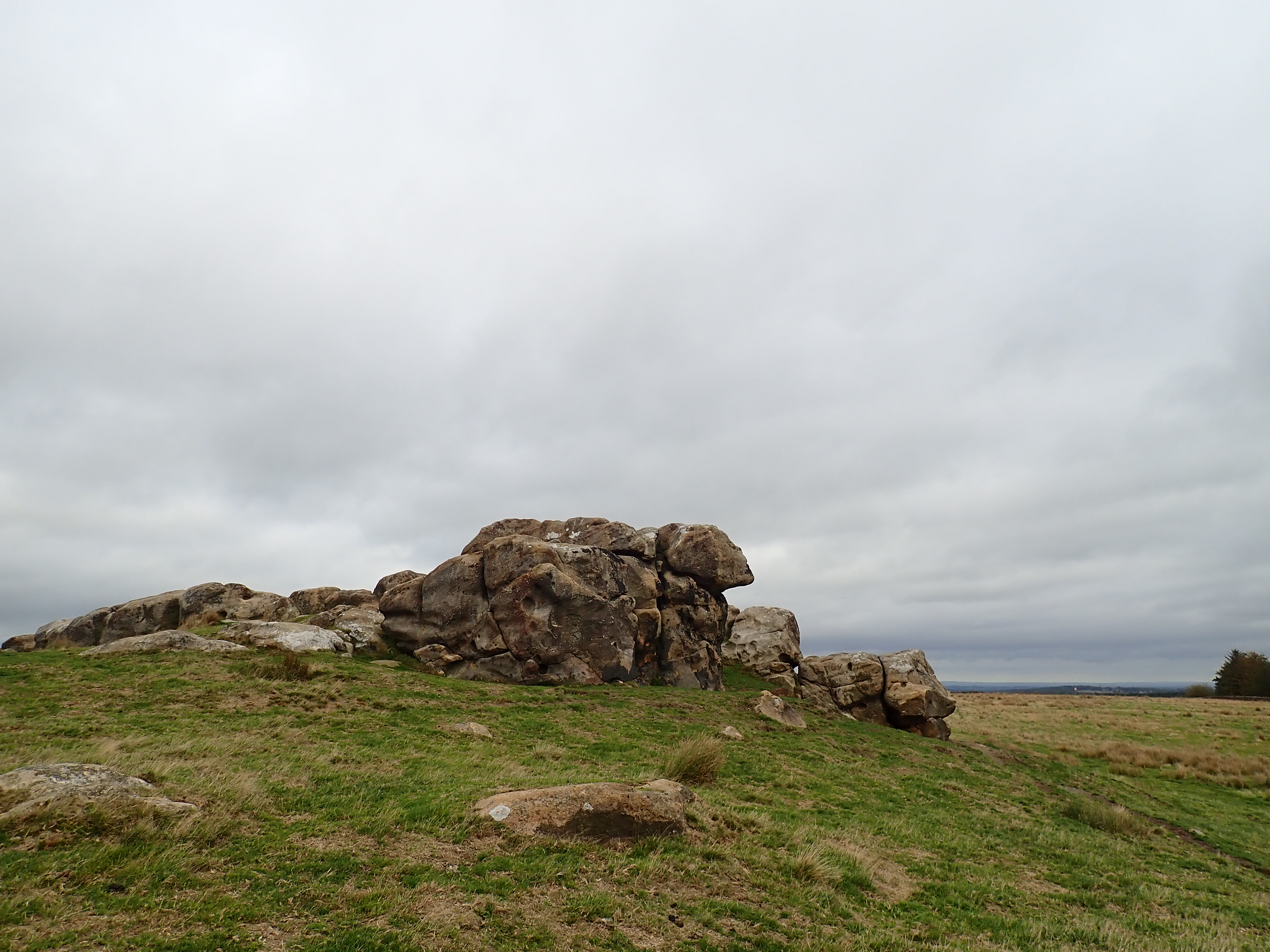
It had somehow been more than two years since I had last climbed at Little Almscliff. I had wanted to go back, as it’s a fantastic, small outcrop of gritstone with interesting, easier bouldering and good views across Stainburn Moor to the Yorkshire Dales. Although the idea of returning occasionally drifted into my head, I never acted on it as there was always something else that had my attention or was more pressing. However, after unfairly pushing a trip to Little Almscliff down my to-do list for a couple of years, I decided to go back to try the bouldering problems I’d missed last time.
The previous trip to Little Almscliff had been on a humid day at the tail end of summer. My more recent trip was on a grey day with a lingering threat of rain, and a biting, cold wind. The one climber that I saw during my trip remarked in a surprised tone about how cold it was, and left the crag about ten minutes later. Apart from a couple of people walking their dogs, the only other person I saw at Little Almscliff was a man dressed in black overalls who spent more than an hour walking around the moor looking at the ground. He would occasionally stop to bend down as if to pick something up. I concluded that he was probably looking for magic mushrooms, and focused on my climbing.
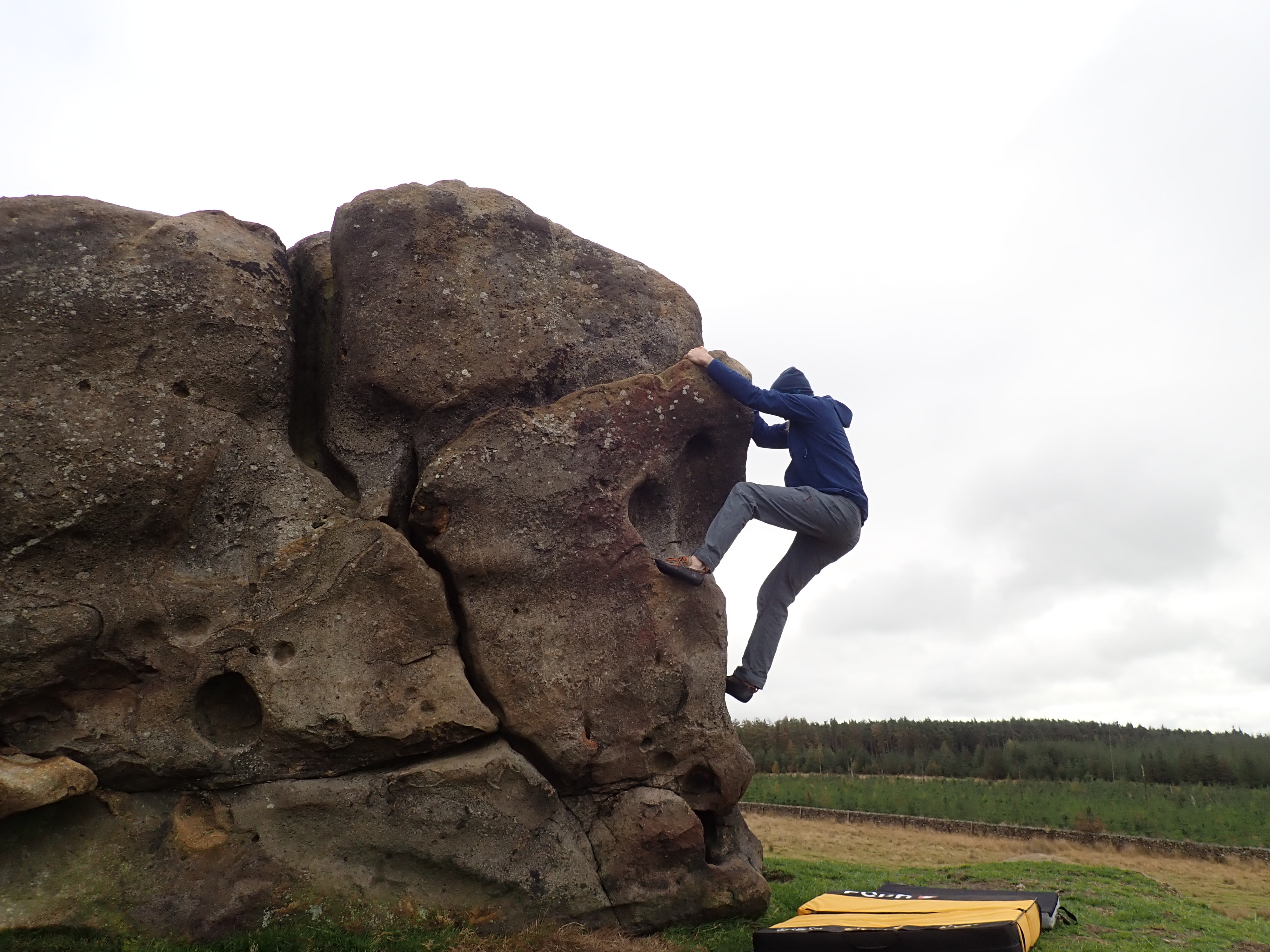
The first piece of rock that caught my attention was a rounded arete, cut across by a rail about three-quarters of the way up. This formed one corner of High Man – the large outcrop that makes up most of Little Almscliff. The left side of this arete is the problem Rail and Arete (4) while the right side is Shiny Arete (4). I tried both several times, as well as climbing a line that was more straight up than to one or other side of the arete. Unfortunately, no matter which line I took, the top-out was still too bold for my taste, and I backed off.
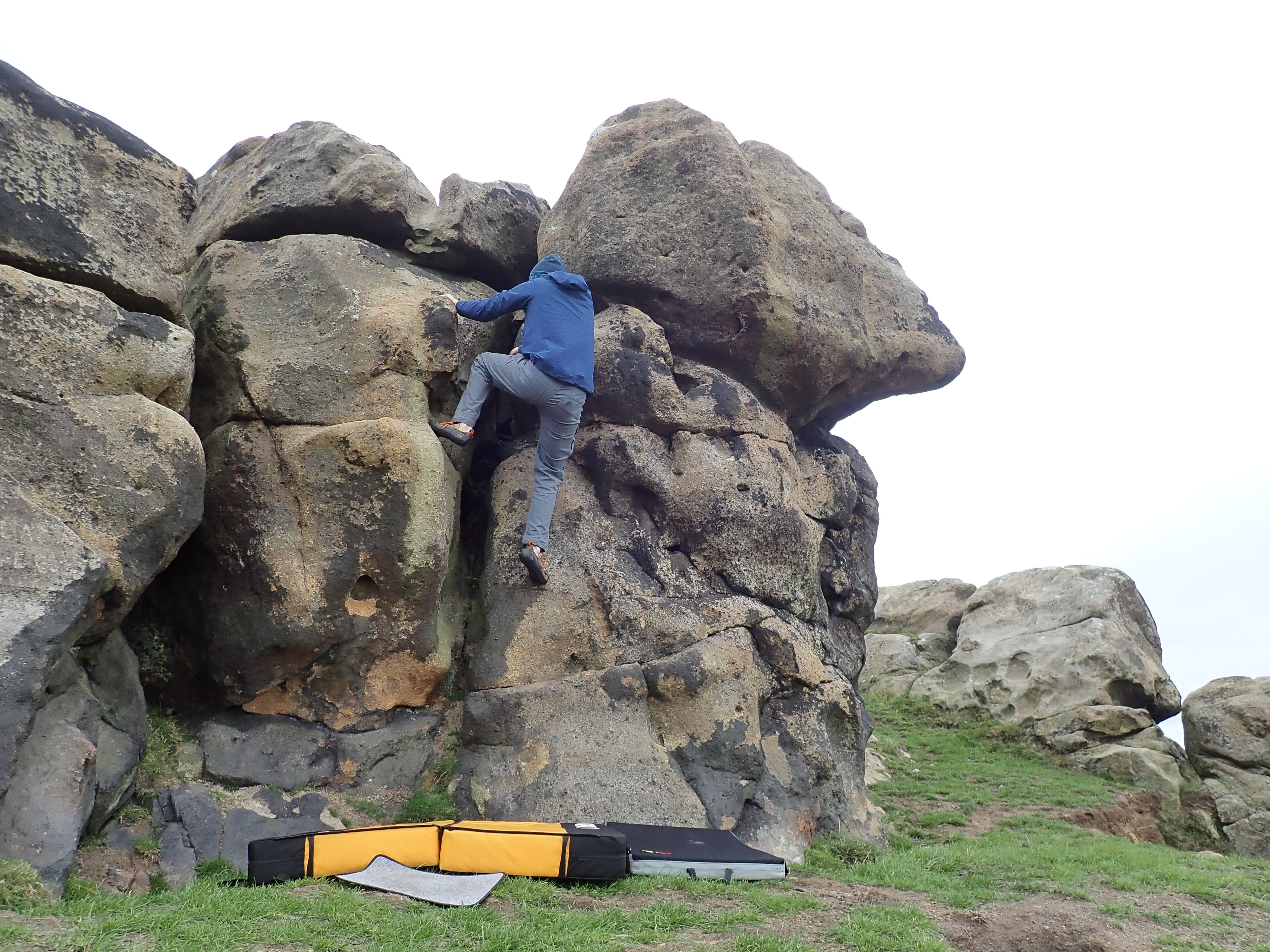
The next problem I tried was Classic Chimney (3). This is more of a large crack than a chimney. It’s one of two large cracks that split the face of High Man from top to bottom. This problem looked straightforward from the ground but involved an unpleasant mix of awkward moves to climb. It was a relief to get to the top.
Following this, I was surprised by how much I enjoyed climbing the second of these two cracks as I flowed up Right Chimney (3) by a pleasant series of moves.
I then headed around to the vertical east face of High Man. I made a few attempts to climb Plaque Wall (4) but kept failing to execute the same move. In the end, I gave up, less because of this move and more because I could see myself spraining or breaking an ankle on the uneven landing if I fell.
The next problem along was the aptly named Big Polished Pockets (4). These pockets made it straightforward to get most of the way up the wall, but the crux is topping out. My tallness certainly helped in getting past this, but it was probably trusting to a high foot placement in the final move that really made the difference in getting to the top.
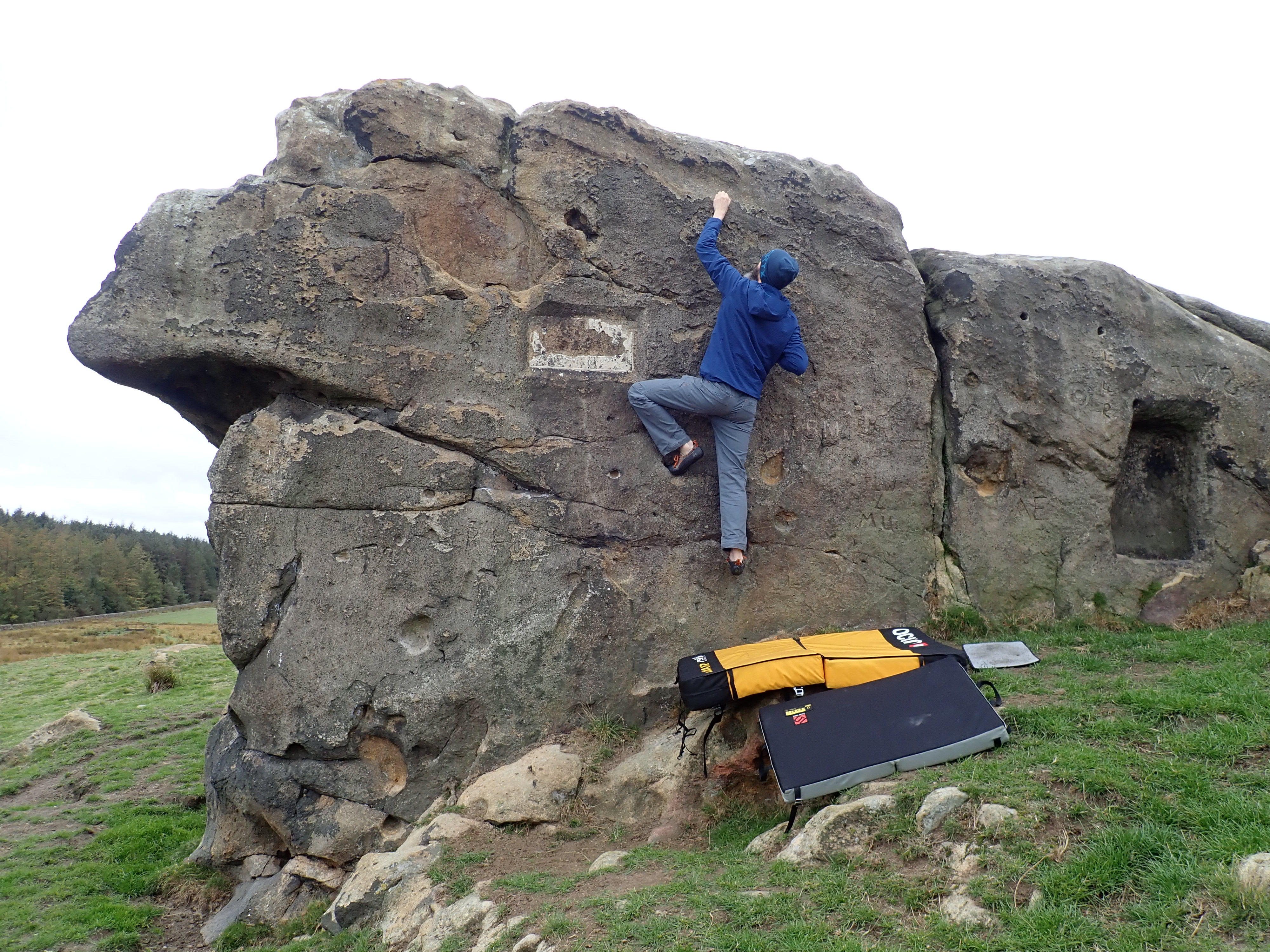
I then had a go at climbing the Crack (3+), which required more effort than its short height would suggest. I did not find it fun.
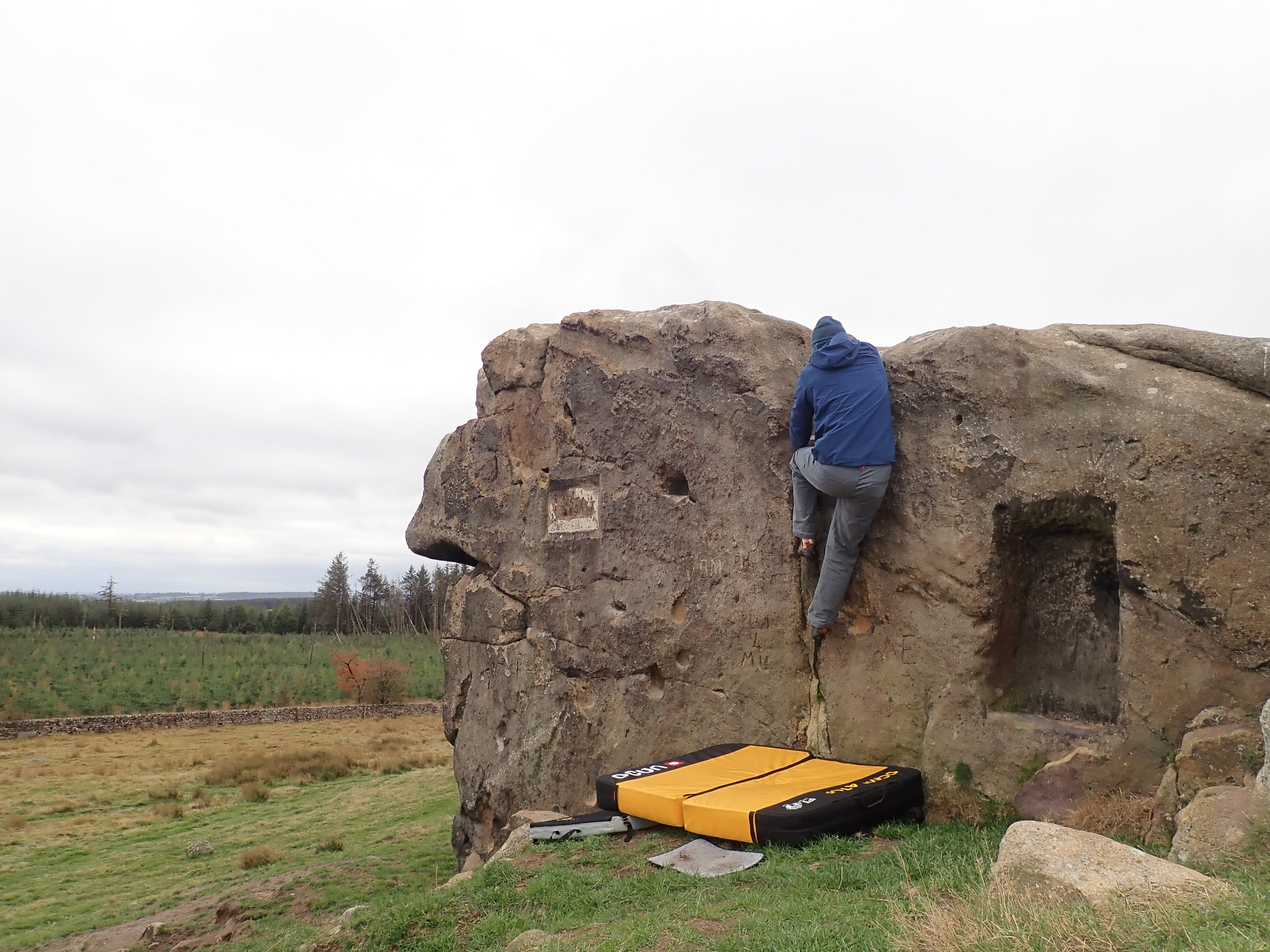
Next to Crack is a Scheduled Ancient Monument, and I stopped to have a proper look at it. Almost hidden amongst the notable number of names and initials carved into Little Almscliff is a prehistoric cup and ring marking. Carvings such as these date to the Late Neolithic and Bronze Age (2800-c.500 BC) and probably had a sacred or religious meaning. I was surprised by how distinct this cup and ring marking was considering its age and its relatively exposed position. It’s good to see that it’s still there.
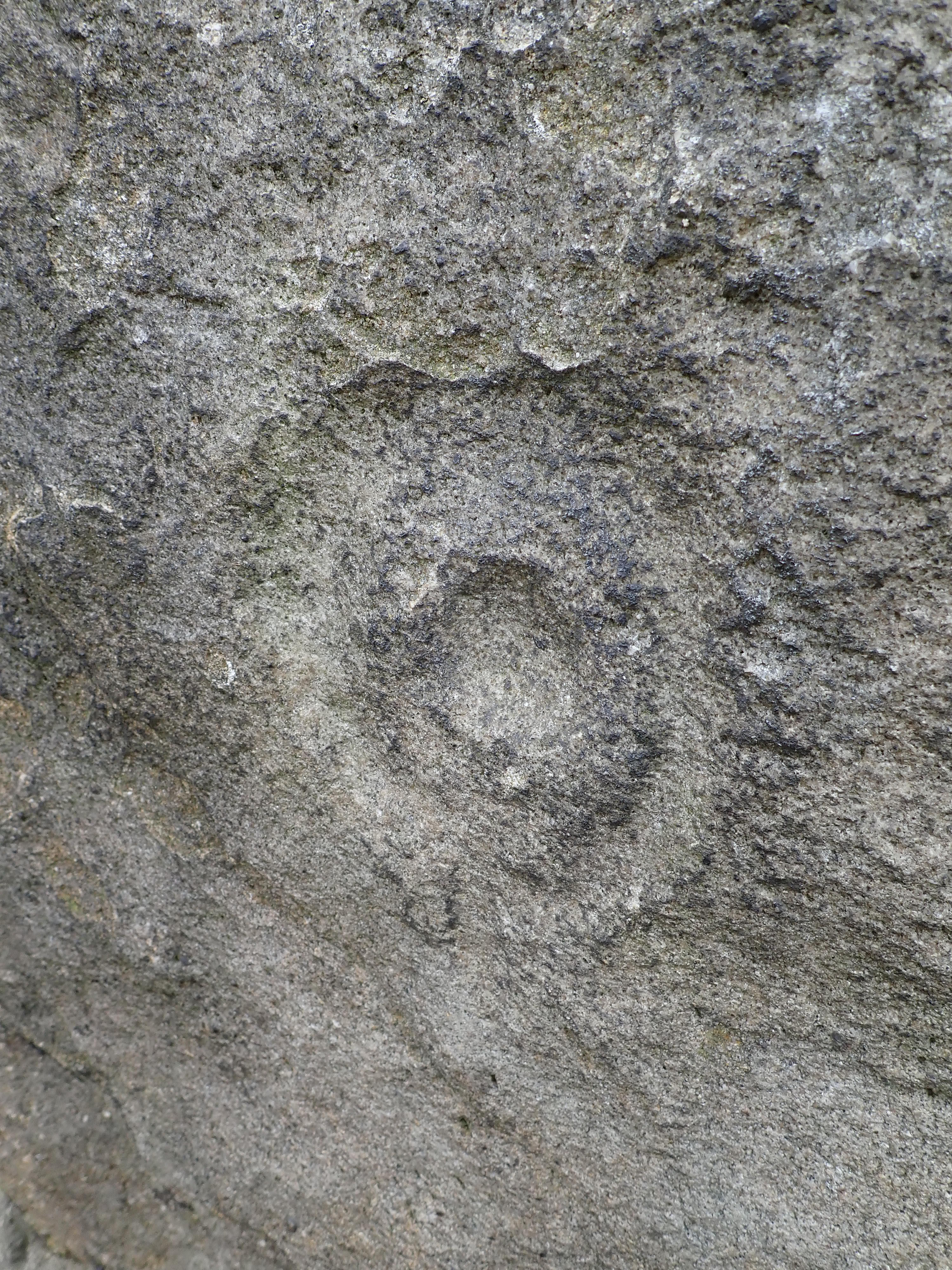
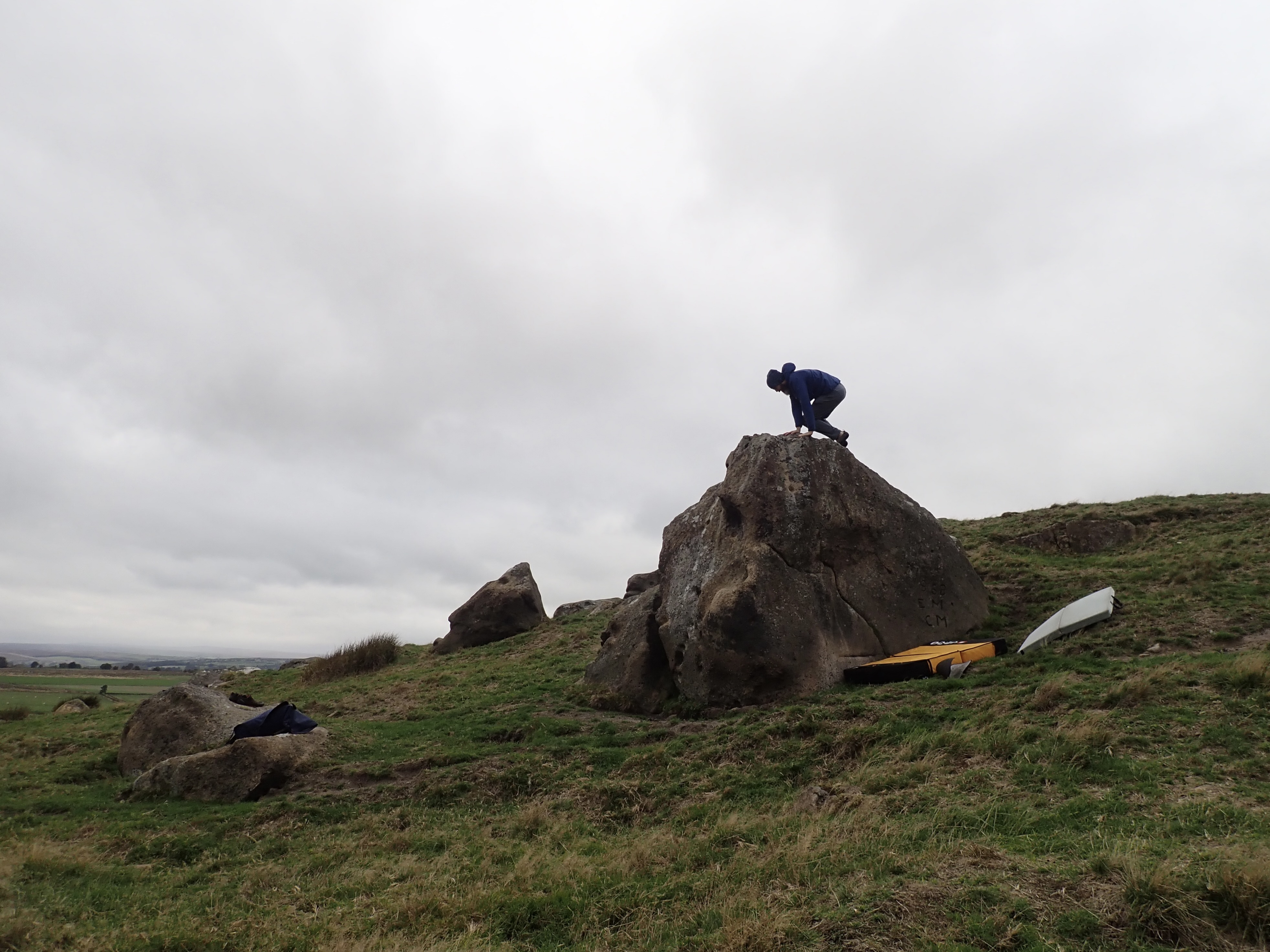
I then headed away from High Man to the free-standing, triangular EM CM 1968 Boulder (named after some non-ancient, carved graffiti on its east face). Here I climbed the ungraded problem Both Blocks. This starts on the smaller of the two blocks that make up the EM CM 1968 Boulder before moving across to the other and up to its top. I thought that this problem looked like it might be lots of fun and was slightly disappointed when I found that it was less interesting than I had imagined it would be.
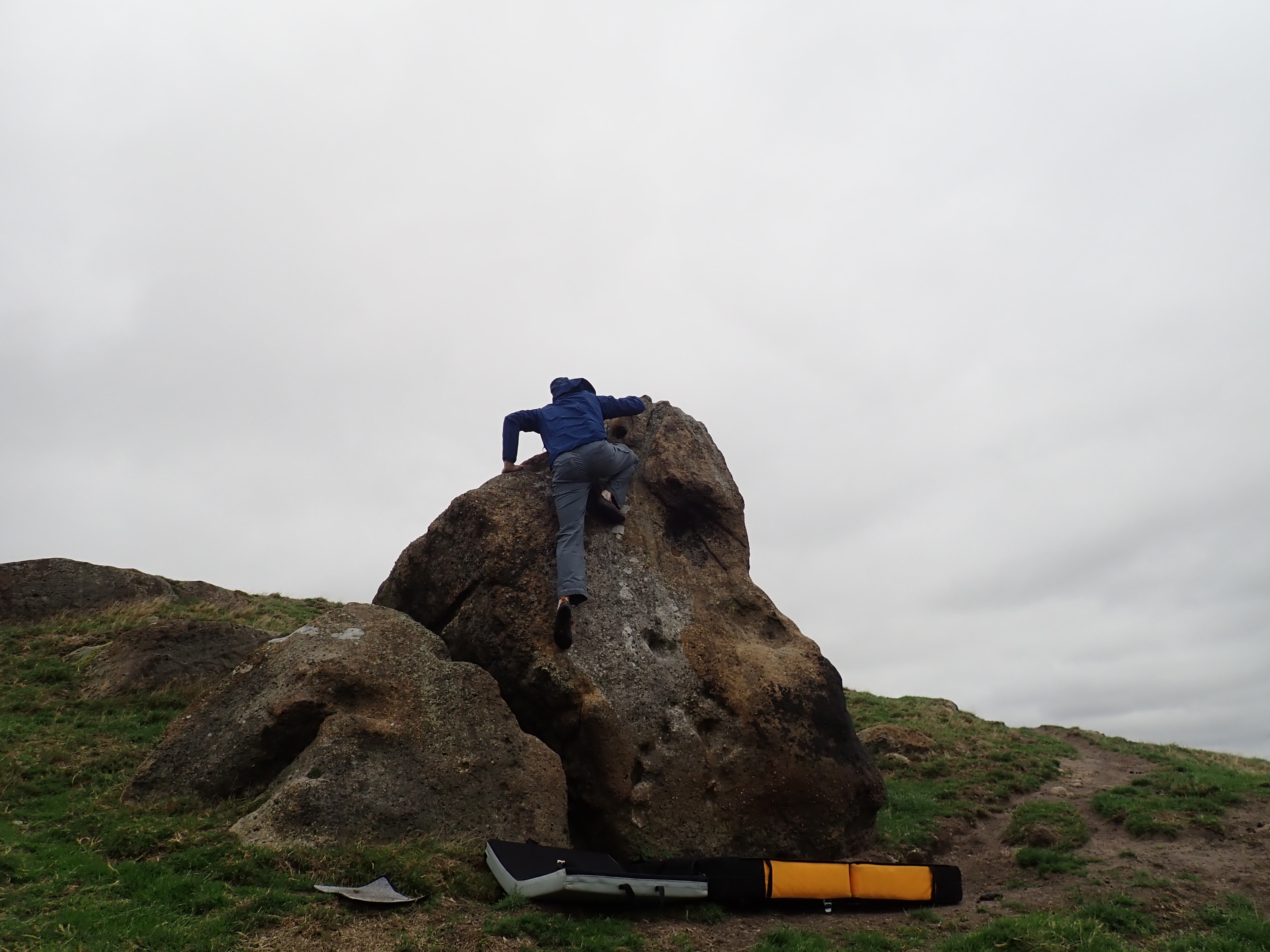
The next problem made up for this. Two Kite (3) goes up one side of the boulder by a lovely sequence of moves involving a crack for your feet and a layback for your hands. It was a perfect little problem to finish on.
Further information
Yorkshire Gritstone, Volume 1, Almscliff to Slipstones (pp.538-539) has topos and descriptions of problems, as well as the usual information on conditions, access, and approach. However, the website 27Crags describes more problems than the Yorkshire Gritstone guidebook and the topo photos are better.
Little Almscliff also features on UKClimbing.
Although it’s known as Little Almscliff in the climbing guides, on the OS map it is marked as Little Alms Cliff or Almais Cliff.
 the Severe climber
Little Almscliffe was my first climb, must be 55 years ago now or thereabouts. I still visit it from time to time but I always find it a bit creepy. It is a strange place…nice post 🙂
I’m glad that you liked the post.
It seems like it would have been a good place for a first climb – not too high and easy to access. Which climb did you do? Did it go well?
Thanks. I really can’t remember. There were a few of us – we also did Cow and Calf, Almscliffe Crag and somewhere near Wetherby whose name escapes me. I only climbed for a couple of years then drifted into caving which I did for 20 off years. But I enjoyed it immensely and often watch the climbers up at Almscliffe Crag 🙂
That’s a good spread of classic Yorkshire gritstone. I’m guessing that a few of the skills you learn climbing can be transferred to caving.
Just remembered it was Plumpton Rocks. We do climbing as cavers but it is much different. Usually it is under waterfalls and with wellies on. It is purely a means to an end. But we use ropes too and abseil and prussick up the rope. All good fun 🙂
That’s funny. Plumpton Rocks is an interesting place, and certainly atmospheric. I don’t think the owners allow people to climb there anymore.
In a way, that’s the opposite of rock climbing, where you spend your time trying to avoid climbing in the wet. I can see how it might be fun in a cave though.
How do you get down off the main area? can you just walk down the back somewhere? And what on earth is that huge square cut out of the rock?
Hi, you just walk off the back. The High Man and Low Man parts of Little Almsliff jut out of a small hillock, with the top of the crag just being a step above the surrounding moor.
The square recess cut into High Man looks like it is the right shape and size to hold a shrine. However, I’ve no idea why it was carved or how long ago it was done. It’s a fairly sizeable recess and so must have taken quite a lot of effort to make. On my last visit a couple of years ago it was just the right size for my son to sit in.
Like that about your son finding it a nice sheltered place to sit and watch!
He did like this little seat.
Never knew about this place when I was climbing in the area. Maybe have a wander there next year.
I think it’s somewhere you could easily not know about. It’s hardly visible from the road.
I’ll be interested to read your post about the walk when you do it.