

I woke up on Saturday morning to clear skies and a crisp frost. The perfect, and long-awaited, combination of perfect gritstone bouldering conditions, and the opportunity to take advantage of them. I got myself ready as quickly as possible and set off for Almscliff to climb some problems I had been hankering after.
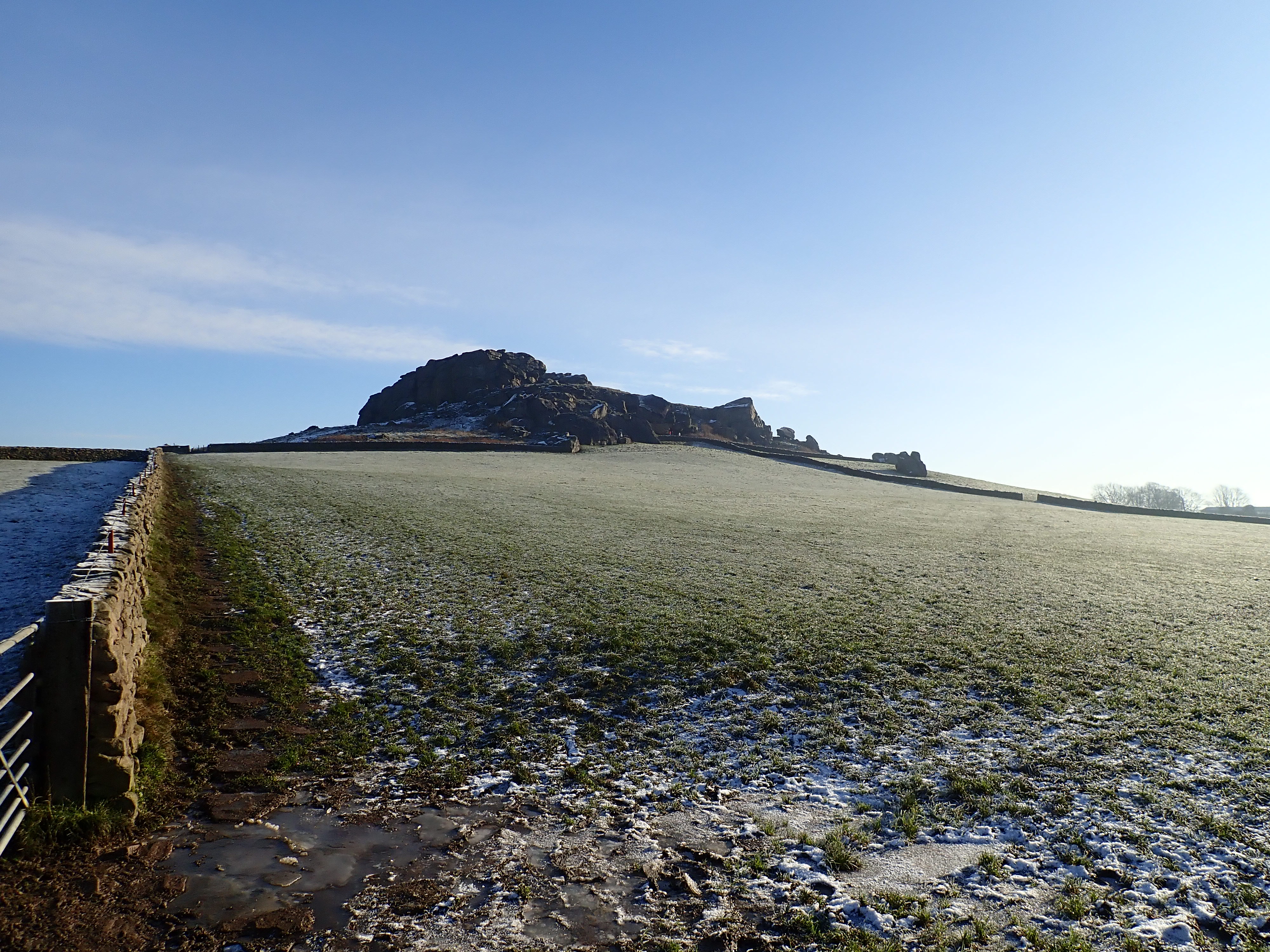
I could hear ice cracking under the weight of my car as I pulled into the lay-by within sight of Almscliff. The waterlogged mud of the layby had turned into a dark brown ice-skating rink, and I cautiously moved around my car as I got my bouldering pads and bag together. In some ways, I was pleased about this perilous ice. The field that leads up to the Almscliff has a reputation for being muddy. In the past, inconsiderate climbers have attempted to sidestep the mud by walking along the top of the drystone wall that runs up the hill. This caused damage to the wall and required it to be regularly repaired. BMC responded to this situation by laying stepping stones up the edge of the field. The farmer who owns the land responded by adding concrete and barbed wire to the top of the wall. But on Saturday, the mud and puddles were frozen solid. I admired the view of Almscliff in golden light, and then walked over the creaking ice and up the hardened field.

The frost was melting where it was touched by the sun, but in the shadow of High Man there was a deep hoar frost. I love conditions like this, and I happily crunched my way around High Man and back into the sunlight. I still wasn’t feeling strong after my cold, and so headed for a collection of easy climbs in the Shothole Arete area that I had not done before.

What I hadn’t realised until I got there was that the Shothole Arete area is in the part of Almscliff that climbers share with a herd of cows (or, perhaps more accurately, the cows share with the climbers). Thankfully, most of the cow pats were frozen, but enough had been warmed by the sun that I had to be careful where I put my feet and my pads.

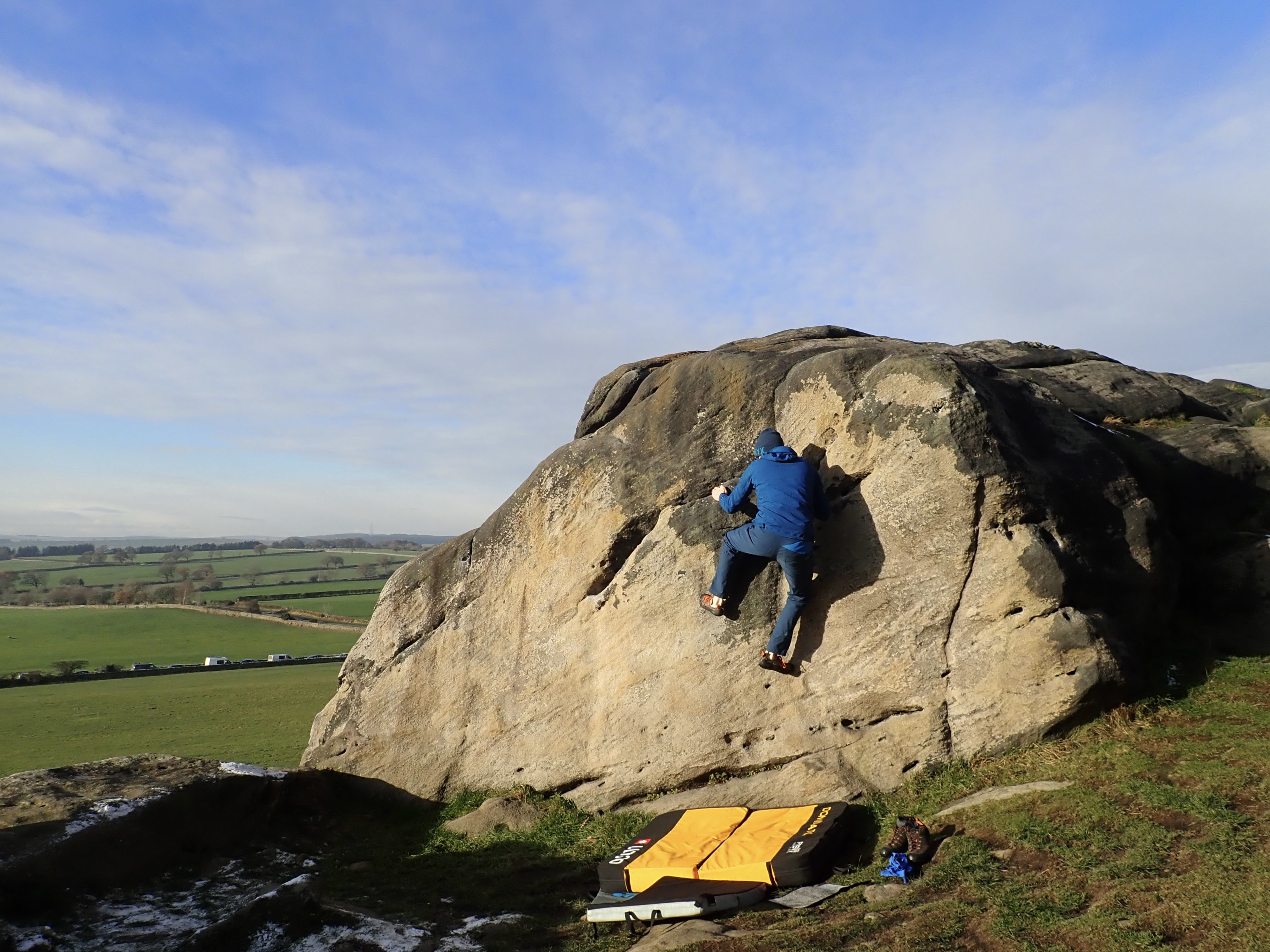
The problems I had been looking for had good pockets and features, but less than ideal landings. While I was slightly uneasy about the ankle-snapping possibilities of jutting-out steps of rock near the bottom of the wall, I also thought I could get up these problems and so wanted to give them a try. Sloping Finish (3) was a straightforward climb that I managed with an inelegant finish. Long Reach (4) was one of those problems that my height makes a bit easier, but I couldn’t work out how to do the last moves. After a few unsuccessful attempts, I accepted that I wasn’t climbing well enough to get to the top. I also accepted that the rock step below the problem meant that it probably wasn’t safe to try the last few moves until I felt stronger.
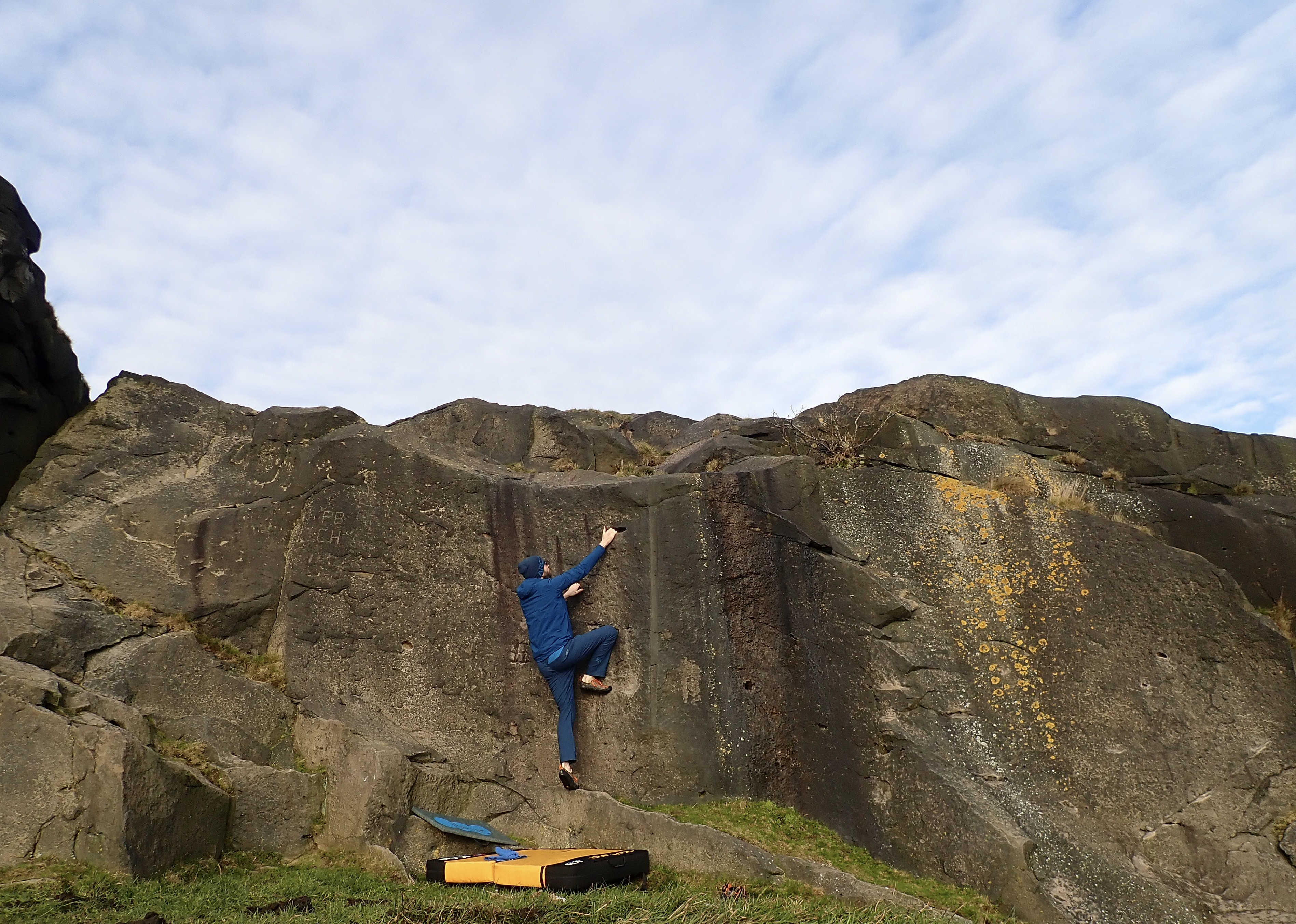
After this, I thought it would be a good idea to try a problem with the word “easy” in the name. So, I walked back into the hoar frost and cold shadow of the North-West Face of High Man to climb Easy Shelf (3). In the past, I’d often seen the North-West Face as the dark and forbidding side of Almscliff, but on this day it looked beautiful in the frost. Walking about in the frost also did a great job of cleaning my rock shoes after my visit to a field frequented by cows.

With both an adjacent drystone wall and a rock below it, Easy Shelf had a notably worse landing than the problems in the Shothole Arete area. Thankfully, it was an easy and delightful problem, and I really enjoyed climbing it. The real issue was getting back down again. A few metres of grass, mud, and rock with a patchy covering of frost separated me from the gentle descent ramp that led back to the ground. I gingerly traversed around the face and felt relief as I reached the ramp.

I decided to finish my trip by seeing if the cold weather would enable me to get up a problem that I had repeatedly failed to climb. It’s said that gritstone has more friction in the cold, and I hoped that this would mean that this would be the day I succeeded in climbing the problem Jemima. I have a disheartening relationship with this climb. The grade of Jemima is so low (it’s only a 3) that I should be able to get up it even on a bad day. However, there is something about this problem that has kept defeating me. I have wondered if there is something about the moves that I’ve been missing, or if there is a fault in my technique. Unfortunately, it seems that the temperature of the rock was not the thing that had been lacking, and I will just have to try this problem another time. Hopefully, it will be on another clear, frosty day.
Further information
There is information on bouldering at Almscliff on the websites 27 Crags and in the guidebook Yorkshire Gritstone, Volume 1. There is also an article on bouldering at Almscliff on UKClimbing.
 the Severe climber
I’ve never been convinced that climbing gritstone’s easier routes is better on a cold day. But there again I’m a sun lover.
Never bouldered at Almscliff but have done most of the better routes up to E1, proper climbing.
I’m interested to know what the science is behind the contention that gritstone has more friction in the cold. It’s something that I’ve heard many times and there may well be a collective wisdom at work there. However, I do wonder whether the rubber of rock shoes would have more traction in warm weather when the rubber would be softer. If it did, would any increased friction on gritstone in cold conditions be negated by the reduced traction of cold rock shoes? I don’t know. Maybe this is why some boulderers (so I’ve heard) keep their shoes warm inside their duvet jackets (before I started thinking about this, I had assumed it was because they didn’t like cold toes).
The bouldering at Almscliff is great. I’ve also got fond memories of trad climbing there in the past.
I’d agree that warm rubber soles have far more grip than cold ones where they will go stiff and hard.
This has prompted me to do a bit of reading to try to find an answer on this. It seems that several reasons are given by climbers for why gritstone has more friction in cold conditions –
1) Gritstone is water permeable. The water that it has absorbed sweats out of the rock in warm weather, making it greasy and so harder to climb. This process doesn’t happen when it’s cold. In addition, humidity is lower in cold weather. This means that there is less water to reduce friction on the rock.
2) Skin temperature is lower in cold weather. As a result, climbers’ hands sweat less and so they get better grip.
3) The rubber soles of climbing shoes get softer in warm weather and harder in cold weather. To grip well the rubber needs to be soft enough to mold to the irregularities in the rock and so increase the contact area between the two surfaces. However, if the rubber is too soft it deforms, and the shoes are more likely to slip off the rock.
There’s a good article on gritstone climbing by Natalie Berry (https://www.ellis-brigham.com/news-and-blogs/true-grit) that touches on how temperature affects gritstone climbing. There is also a fascinating article in Climbing magazine written by David Flanagan that looks at the science of friction and sets out the difference that temperature makes (https://www.climbing.com/skills/learn-this-friction-science/). That encouraged me to look at a copy of his book Bouldering Essentials, which says:
“The best friction is found on cold, dry days. Climbing in the cold is an integral part of outdoor bouldering. It’s the reason why boulderers are associated with woolly hats and down jackets.”
P.111
You’ve unearthed some interesting facts there! I’d prefer to boulder in cold weather (although I don’t boulder as a rule) as you’re much more active. Climbing, when you’re having to wait around a lot, can be a very cold game.
That it can. I have lots of memories of feeling chilly while belaying at the top of a crag. Quite a few of those are from when I was a student and couldn’t afford to buy a belay jacket.
Well I don’t lead and I’ve been bloody freezing waiting at the bottom belaying the leader! I agree the top of the crag is usually lots colder though – especially on windy days!
The bouldering routes look quite fun but all that frost sure doesn’t! I’m a real winter hater – I don’t mind warm, wet winters but really hate all this cold and slipperiness.
I think that there can be different sides to winter. Cold, frosty or snowy, with blue skies is fantastic. Grey, cloudy, dank, rainy days with a cold that penetrates to your bones are not fantastic.
Those winter days which are blue-sky ones are fairly rare though – it always seems to be damp in Britain even when it’s frosty or icy. I can generally cope with hillwalking on cold, dry days but only until the sun dips and it goes much colder.
True, although I think that there can be beauty even on the damp, grey days. It can be in the bare trees, the (extra) flowing water in streams and rivers, and the way mist hangs to the hills. I even enjoy walking in a blizzard (provided I’m appropriately dressed, of course).
I did 5 fells in horrible weather today but really enjoyed being out – I’ve been too busy all the earlier parts of the week. And I love bare winter trees 🙂
That’s cool. I look forward to reading the post.
I won’t be posting about it – I go up the fells most days and only really write up ones where either something ‘exciting’ or unusual happened or the photos were good.