
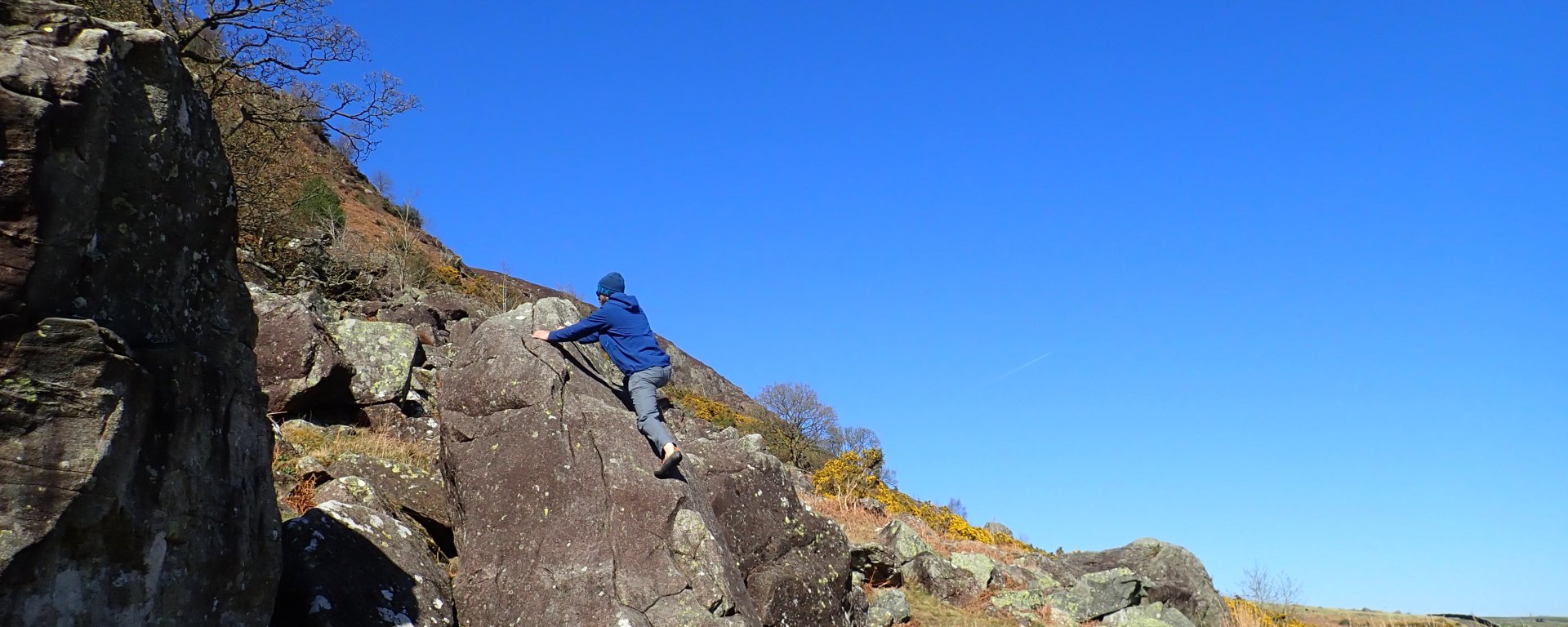
A couple of weeks ago I had a great weekend bouldering on the sharp gabbro boulders of Carrock Fell in the Lake District. The sun shone brightly, the gorse was in bloom, the rock was full of friction, and I climbed well.
Carrock Fell is in the northern Lake District, near the edge of the national park. Its eastern slope is a mix of grass, bracken, gorse, trees and talus below a line of broken cliffs. Towards the bottom of the slope, the gradient eases until the ground becomes flat and boggy. The land then becomes a mix of gentle, rolling hills of pastures and moorland. Scattered randomly across the slope of Carrock Fell are boulders of varying sizes made up of dark, hard and coarse gabbro.

This is a part of the Lake District that I’d not been to before. It was delightful to discover it as I drove along a narrow road that wound through the countryside. The road followed the line of the towering fells and passed through the pretty villages of Mungrisdale and Mosedale. It took occasionally sharp turns around cottages, and crossed a river by a stone bridge, before drawing close to the fell to hug its slopes. The sun was bright, there were daffodils by the roadside, and the trees were coming into bud.

This road runs the length of Carrock Fell, which means that the walk-ins to the climbs are relatively short. On my first day, I carefully parked by a wall and a stream at one end of the climbing area, and headed for the Far North Circuit. This is the home of The Sugarloaf boulder, a rough fin of rock rising from the grass that my guidebook described as:
“An immensely popular boulder featuring great rock and possibly the world’s easiest arete!”
Chapman, G. (2019) Lake District Bouldering, Sheffield: Vertebrate Publishing, p.534.
The world’s easiest arete seemed the perfect problem to warm-up on, and I was keen to climb it. The problem that goes up this rounded, sloping arete is unimaginatively called Left Arete and has been given the lowly grade of 2. Climbing this gave me my first taste of the friction of the rock at Carrock Fell, and this friction is sublime. It made Left Arete such a pleasure to climb that I went up this problem twice. I descended via this problem several more times because I found it the easiest way to get down The Sugarloaf.
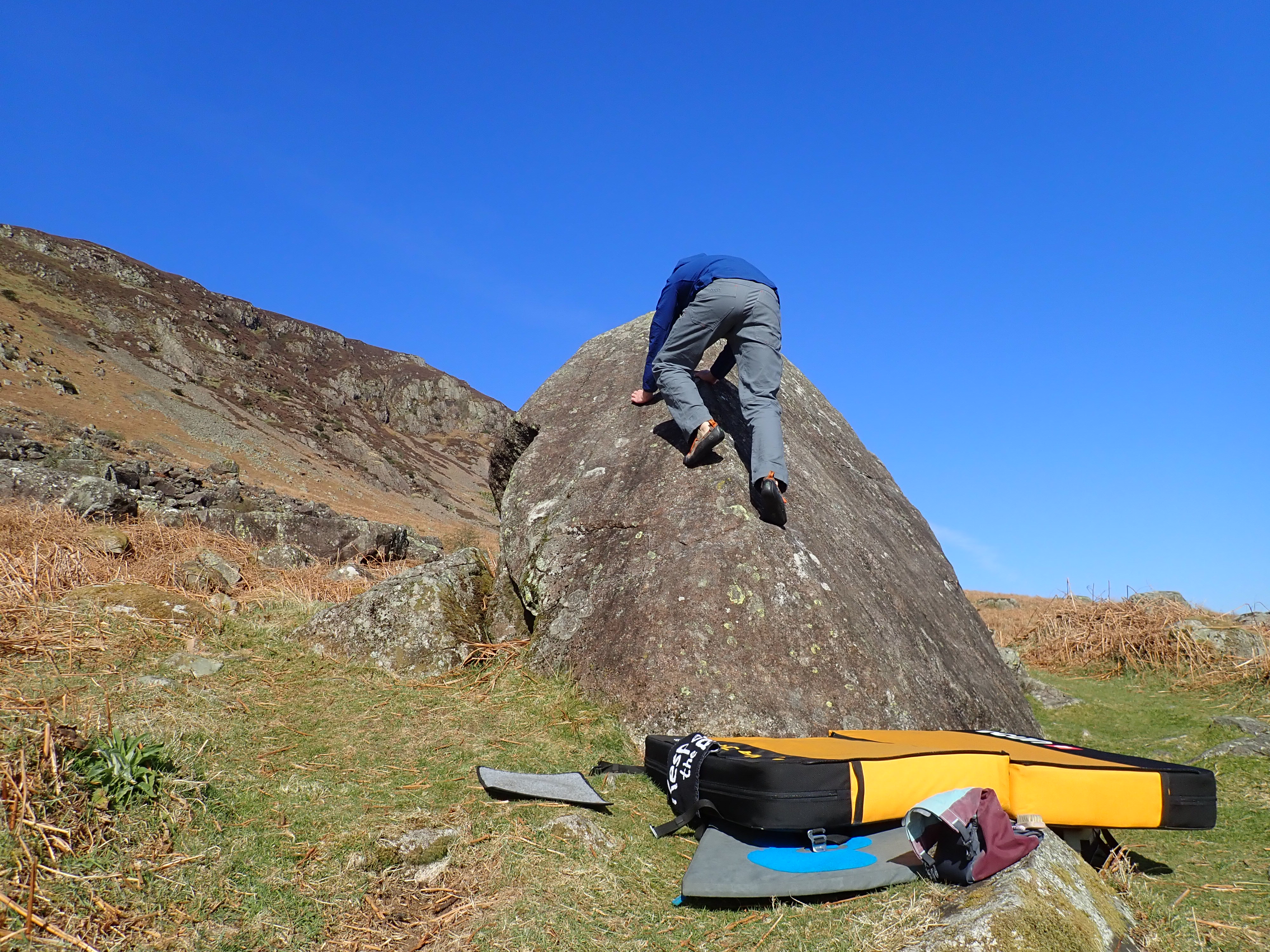
It was around this time that another climber arrived, and we teamed up for the rest of the session. Being able to do this is one of the nicest aspects of bouldering.
The next problem I tried on The Sugarloaf was the unimaginatively named Right Arete (3). This was described in my guidebook as:
“a bit trickier than the left…but not much.”
Ibid.
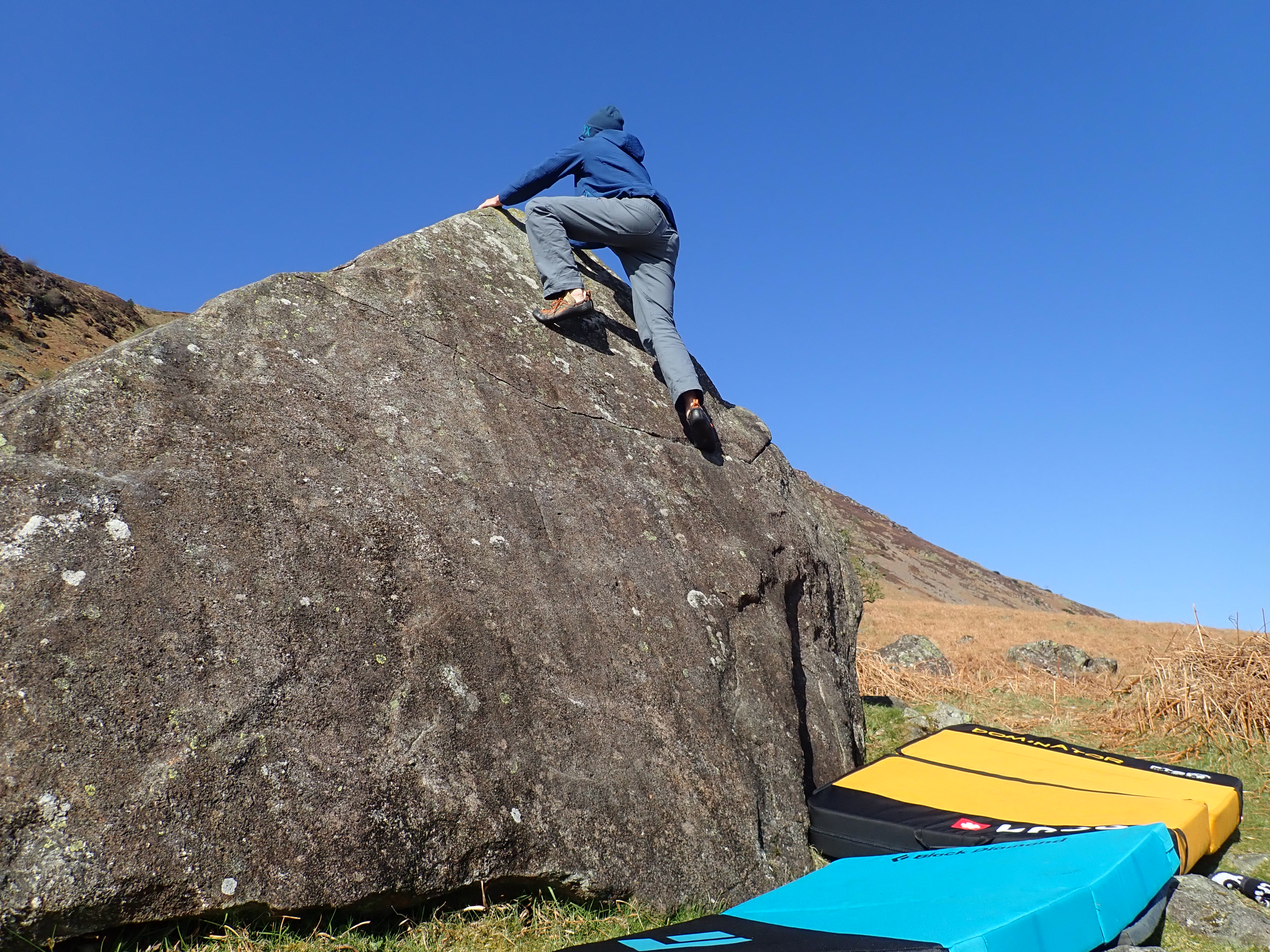
I found it a bit trickier than the guidebook suggested, and I spent some time puzzling over the first few moves. The solution I eventually came up with felt bold and I was pleased with myself for having executed the moves. However, I did have a slight doubt that my approach might have overcomplicated things.

I followed this with Slab Central (3+*) up the middle of The Sugarloaf. I was pleased with how I did on this problem as it required a lot of smearing, and I was impressed with the friction of the gabbro that enabled me to do it.
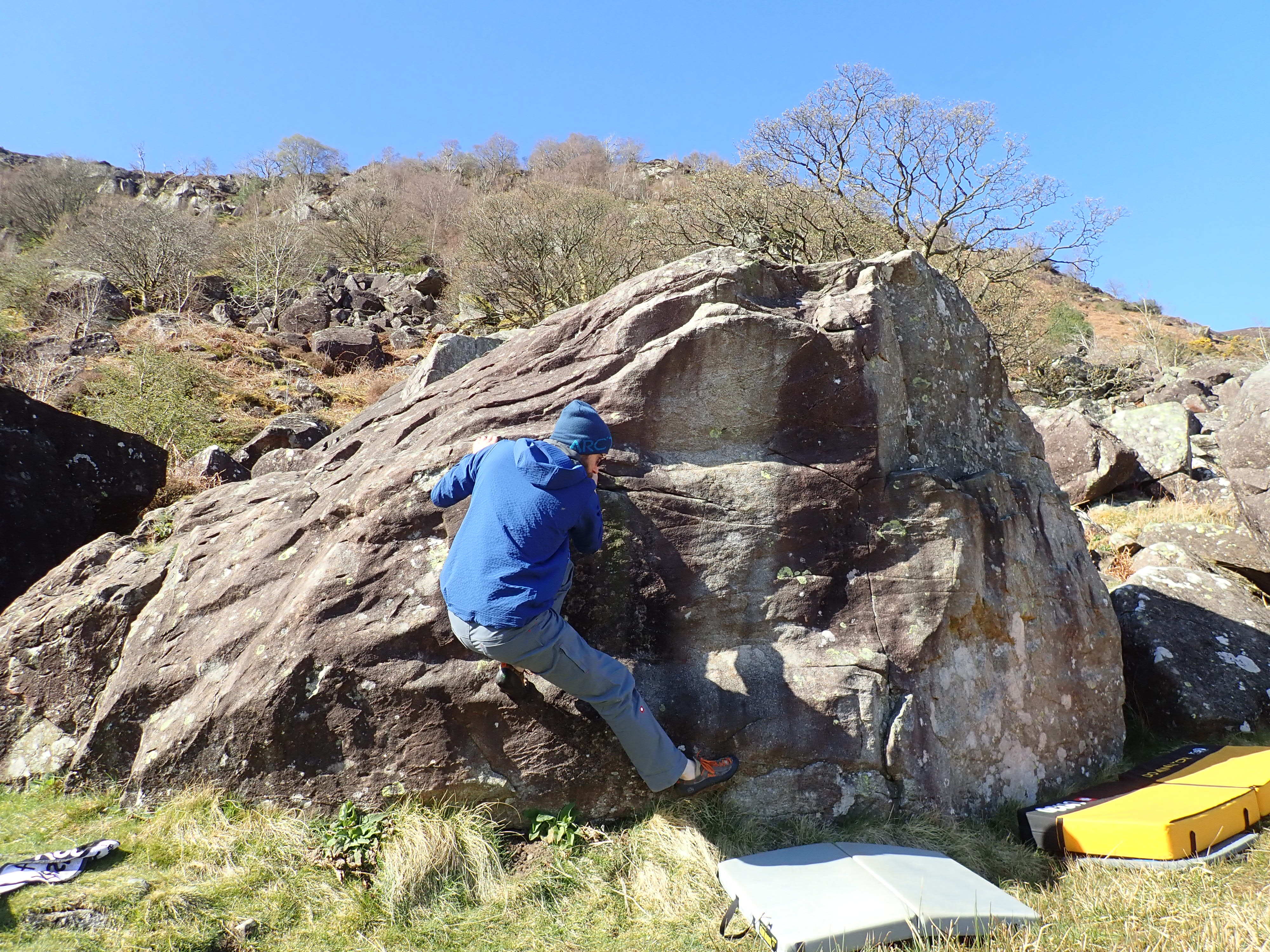
After my last trip to Brimham Rocks, I had decided that I need to do traversing more often so that I can improve my traversing technique. I therefore tried to climb the problem Sugarloaf, a traverse around most of the boulder of the same name. This was ambitious of me considering this problem is a 5+. Unfortunately, my ambition did not match my skill, and I repeatedly came off after a few moves.
We then left The Sugarloaf to climb up the slope to the Gang One Boulder. Here we attempted a beautiful and nameless problem (graded 4) that followed a crack as it rose diagonally across the boulder’s face and then climbed onto its sloping top. Although I managed to climb the traverse several times, I kept failing to pull myself over the lip of the boulder. While the coarse gabbro gave amazing friction, it was making my hands raw. The rock of the Gang One Boulder was particularly sharp, and, in the end, I had to finish climbing for the day because it was too painful, and I was concerned about trashing my hands before the next day of climbing. Feeling slightly disappointed, I made my way back down the fell.

The weather was as glorious the next day as it had been the first. I headed to the Warm-Up Area; a tight collection of irregular boulders only a few metres from the road. I was surprised to discover large puddles in the waterlogged ground in-front of several of these boulders, even though it hadn’t rained in over a week. These puddles required me to be creative and careful in how I placed and used my pads to avoid everything getting soaked (although I didn’t manage to stop them all getting a bit muddy and soggy).

Despite the unexpectedly boggy ground, the Warm-Up Area was a lovely little playground for bouldering. I spent a while happily scrambling over the rocks before moving on to a listed problem. This was Frustration Slab, described as a “Technical slab” (ibid.) in my guidebook and given a grade of 5*. This goes up a vague corner on a laidback triangle of rock. It’s a brilliant little problem that I climbed twice. However, this time I repeated the problem because I found it easy, and thought I must have followed the wrong line up the rock. I checked my guidebook before trying it again and eliminating some holds that I had used the first time. Yet I still found Frustration Slab great fun, straightforward, and not what I would expect from a problem of its grade. Feeling a little perplexed, I moved on to the next problem.

I decided that I should carry on practising my traversing, and so had multiple unsuccessful attempts at a nameless problem (graded 5) that traversed a block from left to right. I felt that my traversing technique was improving, but I also felt that my fingers were raw and slightly bruised from the gabbro. I therefore decided to stop for the day. The skin on my fingers was so worn down that it would be several days before the fingerprint scanners on my phone and laptop accepted who I was. Despite this, it had been terrific weekend.
Further information
The guidebook Lake District Bouldering by Greg Chapman has extensive information on Carrock Fell. There is also a video on UKClimbing that describes bouldering at Carrock Fell and offers tips for a visit.
 the Severe climber
I only live 12 miles away – you should have called round!
I always wonder how you guys don’t break your ankles getting to and from the various boulders amongst that lot!
The gabbro on the Cuillin Ridge took the ends completely off my fingers more than once and ground lots of rock dust under the edges of the remaining skin – very painful indeed! At least it gave us bloody trails to follow on the routes if we came back the same way!
I was certainly in the neighbourhood, and it looks like a good neighbourhood to be in.
Walking very carefully is the answer. It’s not made easier at Carrock Fell by some of the talus being overgrown or partially overgrown. Definitely something you have to walk carefully on.
I guess you pay the price for the friction of gabbro. However, what you experienced on the Cuillin Ridge sounds nasty.
Trying to put a photo in my comment from my blog of when I had ‘Cuillin Fingers’ – didn’t work. Anyway, it’s near the end of my post:
Those fingers look really bloody and bruised. It must have been both painful and inconvenient. How long did your fingers take to heal?
at least 3 or 4 days. I could get washed (water didn’t hurt) but couldn’t go anywhere near a towel!
I had imagined that it might be a week or more, but that’s still a lengthy time to have injured fingers.
It taught me that, as I’m so grabby on the Cuillin, not to ever do more than 2 days in a row!